
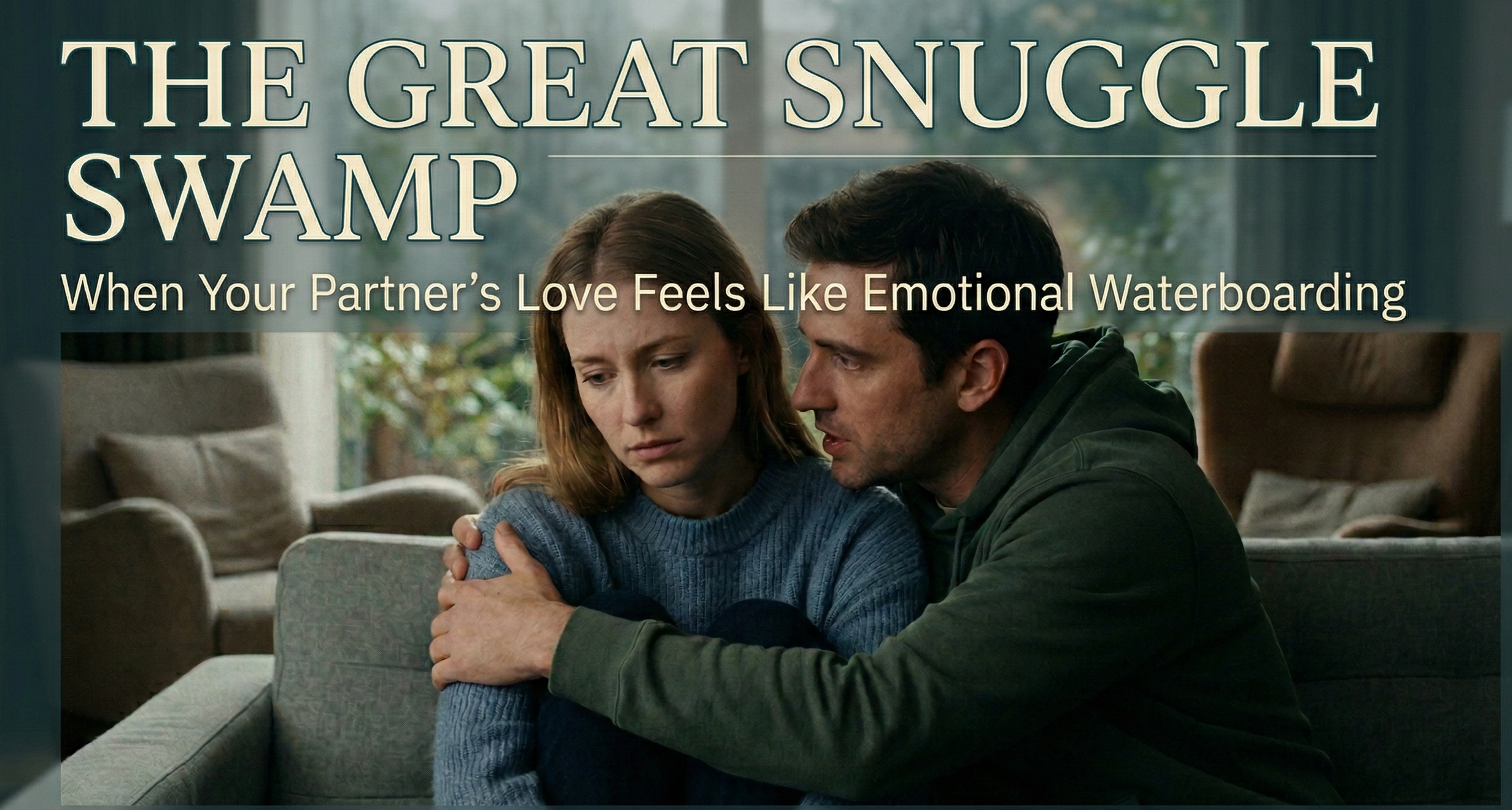
A clinical sexologist’s guide to navigating anxious attachment, personal space, and why “I need space” doesn’t mean “I’m leaving you”
By Ms. Erin Alexander, Clinical Sexologist
What Is The Great Snuggle Swamp?
Hello, darlings. Ms. Erin here, your friendly neighborhood clinical sexologist, ready to wade into the delightful, messy, and occasionally suffocating world of couple dynamics.
Today we’re discussing a phenomenon I affectionately call “The Great Snuggle Swamp” that murky relational territory where one partner’s completely genuine desire for closeness turns the other partner’s personal space into an endangered ecosystem.
It’s the moment when “I love you and want to be near you” gets translated by an anxious brain into “I am sitting on your chest so you can never leave, and is that a faint pulse I feel? Good, you’re still breathing.”
Sound familiar?
If you’ve ever felt like you need a hazmat suit just to get five minutes alone in your own home, or if you’ve ever panicked when your partner didn’t text back within 47 seconds, welcome. You’re in the right place.
This is about attachment styles colliding, personal space becoming a battlefield, and how to navigate this without anyone suffocating (literally or metaphorically).
Meet Samantha & Victor: A Love Story Featuring Excessive Hovering
Let me introduce you to a genuinely loving couple who’ve hit a temporary snag in their relational rhythm. It’s less like a gentle duet and more like a competitive drum solo happening right outside Samantha’s office door.
Samantha: The Secure Attachment Champion
Samantha, bless her well-adjusted heart, operates with a secure attachment style. She views the relationship like a comfortable home base—a place to return to, not a maximum-security prison from which she must never stray.
She’s also a natural collaborator when conflict arises. If they hit a relational bump, she pulls out her metaphorical negotiation hat and says, “Let’s build a bridge we can both walk across together.”
Her conflict style: Collaborative problem-solving Her attachment: Secure (relationships are safe, predictable, and don’t require constant vigilance)
Victor: The Anxious Attachment Paddler
Then there’s Victor. Ah, Victor.
He’s paddling furiously in the anxious-attachment lagoon. When the relational waters get even slightly choppy, his internal alarm system goes off, screaming: “Abandonment! Emergency! Hug Samantha until she physically cannot leave!”
He wants closeness—not because he doubts her love, but because a constant, tangible, physical presence is how his brain desperately tries to shout down its own anxiety about being left.
His conflict style: Competitive (initially), but open to compromise (his saving grace) His attachment: Anxious (relationships require constant monitoring and physical proximity to feel safe)
When they argue, Victor’s first instinct is to win the point, probably by presenting a meticulously researched PowerPoint presentation on why his feelings are objectively correct and supported by data.
But here’s the beautiful saving grace: he is genuinely open to compromise. He just needs to be assured that the compromise won’t involve Samantha moving to a remote island inhabited only by goats and blissful silence.
Understanding Attachment Styles: The Crash Course
Before we dive into the solution, let’s quickly understand what’s happening here neurologically and psychologically.
Secure Attachment (Samantha)
Core belief: “Relationships are generally safe. People I love will probably stick around. I can handle both closeness and independence.”
Behaviors:
- Comfortable with intimacy and autonomy
- Can self-soothe when partner is unavailable
- Communicates needs directly
- Doesn’t panic when partner needs space
In relationships: Balanced, collaborative, emotionally regulated
Anxious Attachment (Victor)
Core belief: “People I love might leave at any moment. I need constant reassurance. Physical proximity = safety.”
Behaviors:
- Craves constant closeness and reassurance
- Monitors partner’s mood and availability obsessively
- Interprets small changes as potential abandonment
- Has difficulty self-soothing when alone
In relationships: Intense, needs frequent connection, can be perceived as “clingy” or “demanding”
The thing nobody tells you about anxious attachment: It’s not a character flaw. It’s a nervous system response developed (usually) in childhood when love felt unpredictable or conditional.
Victor’s brain genuinely believes that if he’s not physically present, Samantha might forget he exists or realize she doesn’t need him.
Is this rational? No. Is this how his nervous system actually works? Absolutely yes.
Understanding this distinction is essential.
The Current Crisis: Operation Human Backpack
The scenario is classic and probably happening in approximately 40% of households right now:
Samantha is absolutely slammed. Her job is demanding. Her to-do list is apparently mating and multiplying in the dark. She needs space. She needs quiet. She needs a protective bubble around her with a force-field rated to repel both client deadlines and overly enthusiastic snuggles.
Victor, sensing the slightest withdrawal, a delayed text response, a desire to read a book alone for 45 minutes, a closed door—interprets this as a Category 5 emotional hurricane headed directly for their relationship.
His anxious attachment kicks into overdrive, leading to what I affectionately call “Operation Human Backpack.”
The Symptoms of Operation Human Backpack:
Scenario 1: Cooking Dinner
- Samantha is trying to prepare food
- Victor is hovering inches away, offering helpful but deeply distracting commentary on proper onion-dicing technique
- “It’s just… you’re being a little aggressive with that onion, darling. Are you mad at the onion? Or at me?”
Scenario 2: Work Call
- Samantha is on an important professional call
- Victor is “quietly” (read: not quietly at all) reorganizing the spice rack three feet away
- Occasionally making intense, reassuring eye contact through the kitchen doorway
- Mouthing “I love you” at inappropriate moments
Scenario 3: Bedtime
- Samantha finally gets into bed, hoping for five glorious minutes of horizontal peace
- Victor performs a full-body clamshell maneuver
- He’s now utilizing approximately 90% of the mattress surface area
- Breathing heavily into her hair with what can only be described as aggressive affection
Samantha’s Internal Monologue:
“I love him. I genuinely, deeply love him. But if he asks me one more time if I’m ‘okay,’ I am going to scream the word ‘SPACEEEEEEE’ into the abyss and see if the universe answers.”
She feels:
- Guilty (because she loves him and doesn’t want to hurt him)
- Suffocated (because her personal space has been colonized)
- Increasingly desperate (because she can’t recharge her batteries with someone literally sitting on them)
The Ms. Erin Prescription: Space Is Not A Four-Letter Word
Here’s where we apply clinical psychology, collaborative problem-solving, and a healthy dose of humor.
The good news: This is completely fixable.
The better news: Both Samantha and Victor have the attachment styles and conflict approaches that make this solvable.
The best news: You can implement these strategies starting tonight.
Practical Strategies That Actually Work
Strategy 1: Scheduled Snuggles & Strategic Solitude
Since Victor is open to compromise and Samantha is a natural collaborator, they need a formal negotiation with clear boundaries and specific time blocks.
Samantha needs to clearly articulate her need for solitude, not as rejection, but as essential fuel for being a good partner.
Samantha’s Script (The Secure, Collaborative Approach):
“Victor, I love you. My tank is empty. To be a good partner to you, the partner you deserve, I need an hour a day where I am completely unavailable. I need Strategic Solitude.
Let’s look at the calendar together. From 7:30 to 8:30 PM tonight, I am reading / meditating / staring blankly at a wall. I need you to honor the bubble. No texts. No questions. No onion commentary.
But here’s the deal: From 8:30 to 9:30 PM, we have Scheduled Snuggles. You get my full, undivided, non-anxious, completely present attention. Deal?”
Why this works:
- Victor gets a specific time when he’ll receive attention (reduces anxiety)
- Samantha gets predictable alone time (reduces resentment)
- Both parties feel heard and their needs matter
- Clear boundaries reduce conflict
Pro tip: Put this on the actual calendar. Make it visual. Victor’s anxious brain needs to see that connection time is scheduled and guaranteed.
Strategy 2: Redefining Closeness (Victor’s New Job Description)
Victor, your anxious attachment is a well-meaning but overzealous bodyguard who thinks his job is to prevent all possible abandonment by maintaining constant physical contact.
He needs a new job description.
Closeness doesn’t always mean physical proximity. It can mean:
- Shared activity in the same space
- Verbal reassurance at scheduled times
- Emotional availability without physical hovering
Victor’s New Assignment: Parallel Play for Adults
Remember parallel play? When toddlers play near each other without directly interacting but feel comforted by proximity?
Adults can do this too.
How it works:
- Samantha is reading on the couch? Victor is nearby with headphones, playing a video game or listening to a podcast
- Samantha is working? Victor is in the same room, doing his own task (actually doing it, not staring at her)
- The proximity is maintained (which genuinely calms Victor’s anxious nervous system)
- The smothering pressure is eliminated (which allows Samantha to actually relax)
Key rule: No intense eye contact. No “checking in” every four minutes. No commentary on her activities.
Just peaceful, parallel presence.
Strategy 3: The Humorous Signal System (The Code Word)
Since Samantha is stressed and sometimes can’t articulate her need for space politely, a code word is essential. Something ridiculous to cut the tension and prevent resentment.
Suggested Code Word: “Pickle Jar”
How it works:
If Victor is hovering, staring, or about to ask for the 17th time if she’s okay, Samantha simply says:
“Honey, I’m feeling a little Pickle Jar right now.”
Translation: “I’m sealed shut. I need a break. If you try to open me with force, I might explode and cover you in brine.”
Why this works:
- It’s humorous (reduces tension immediately)
- It’s clear (no ambiguity about what’s needed)
- It’s not personal (not “you’re annoying me” but “I need space”)
- Victor’s competitive side feels satisfied because he successfully “read the code”
- His commitment to compromise means he has to honor it and back off
Alternative code words:
- “Cactus Mode” (I’m prickly, maintain distance)
- “Hermit Crab” (I’m retreating into my shell, be patient)
- “Airplane Mode” (I’m temporarily unavailable, normal service will resume)
Choose something that makes you both laugh. Humor is relational glue.
Strategy 4: The Anxiety Externalization Exercise (For Victor)
Victor’s anxious attachment isn’t who he is, it’s a pattern his nervous system learned.
Exercise: Name The Anxious Voice
Give the anxious part of Victor’s brain a name. Something slightly ridiculous.
Examples: “Worried Walter,” “Panicky Pete,” “Clingy Carl”
How it works:
When Victor feels the urge to hover, he pauses and thinks: “Is this ME wanting closeness, or is this Worried Walter freaking out?”
Then he can say to Samantha: “Hey, Worried Walter is having a moment and wants to check if we’re okay. Can you give him a quick reassurance?”
Samantha can respond: “Tell Worried Walter that we’re completely fine, I just need to finish this email, and I’ll find him for snuggles in 20 minutes.”
Why this works:
- Externalizes the anxiety (it’s not Victor’s fault)
- Creates space between Victor and his anxious thoughts
- Allows Samantha to respond with compassion instead of frustration
- Makes the dynamic less personal and more manageable
Pro tip: Samantha can also name her own space-needing part. Maybe “Boundary Barbara” or “Solitude Sally.” Now they’re both just managing their internal characters instead of fighting each other.
Strategy 5: The Pre-Emptive Reassurance Ritual
Victor’s anxiety spikes when he perceives distance. The key word is perceives.
The solution: Pre-emptive reassurance before Samantha needs space.
How it works:
Before Samantha retreats for her Strategic Solitude hour, she gives Victor 30 seconds of undivided, intentional connection:
- Makes direct eye contact
- Holds both his hands
- Says clearly: “I love you. I’m not upset with you. I need to recharge so I can be fully present with you later. I will come find you at 8:30 for snuggles. You are safe. We are good.”
This 30-second investment:
- Gives Victor’s anxious brain the reassurance it craves
- Allows Samantha to retreat without guilt
- Prevents the hovering before it starts
- Creates a positive association with alone time
Victor’s job: Believe her. Trust the words. Let her go.
The Bottom Line: The Swamp Is Navigable
The Great Snuggle Swamp doesn’t have to sink your relationship.
With a little humor, a lot of honesty, strategic planning, and genuine collaborative spirit, Victor can learn that letting Samantha breathe means she’ll come back for the best, most oxygenated, enthusiastic snuggles later.
And Samantha can learn that Victor’s need for reassurance isn’t manipulation or clinginess, it’s his nervous system genuinely trying to feel safe, and a little intentional connection prevents a lot of desperate hovering.
The Essential Truths:
For the Samanthas (Secure Attachment, Space Needers):
- Your need for space is valid and healthy
- It’s not rejection, it’s self-care that benefits the relationship
- Clear, kind communication prevents resentment
- Pre-emptive reassurance is a small investment with huge returns
For the Victors (Anxious Attachment, Closeness Seekers):
- Your need for reassurance is valid and understandable
- Closeness can be redefined beyond physical proximity
- Respecting boundaries actually creates more genuine intimacy
- Your partner’s need for space is not abandonment
For everyone:
- Attachment styles are patterns, not destiny
- With awareness and practice, they can be modified
- Humor and compassion are your best tools
- No one is the villain here, you’re both just trying to feel safe and loved in different ways
The Action Plan:
- Tonight: Have the Scheduled Snuggles / Strategic Solitude conversation
- Tomorrow: Implement the code word system
- This week: Try Parallel Play for Adults
- This month: Practice pre-emptive reassurance before alone time
- Ongoing: Name and externalize the anxious thoughts
You’ve got this. Your relationship can absolutely navigate the Snuggle Swamp.
Now, if you’ll excuse me, I need to go get a hug. My own internal Victor is starting to tap his foot impatiently, and my internal Samantha is eyeing the door.
Balance, darlings. It’s all about balance.
This article is for informational and educational purposes only and does not constitute medical or psychological advice. Please consult with licensed professionals for personal concerns.
