
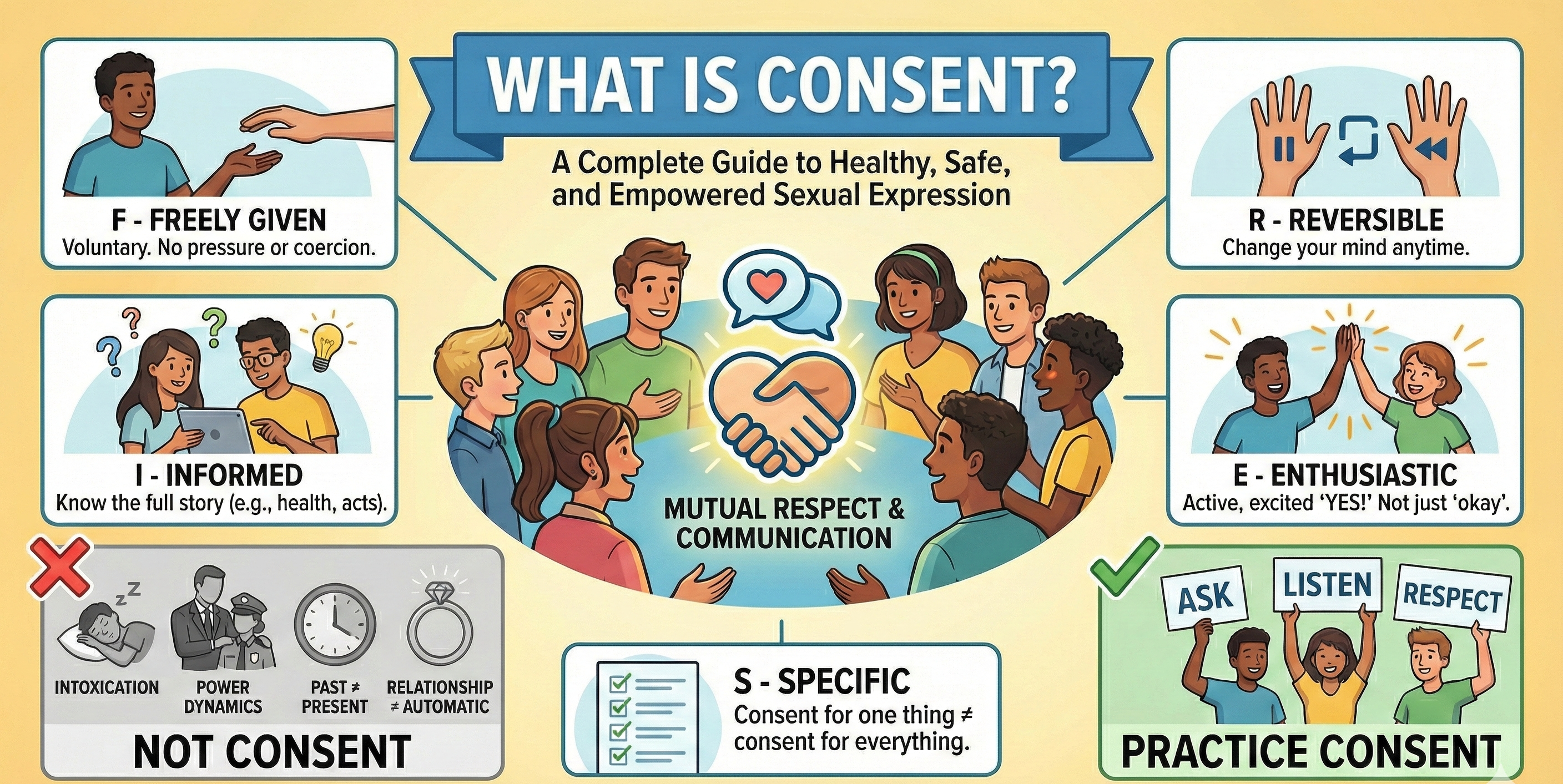
Consent is one of the most essential foundations of healthy intimacy, yet it is also one of the most misunderstood. People often confuse silence with agreement, mistake past intimacy for present permission, or underestimate the emotional and legal weight consent carries.
With experience as a former Presentence Investigator, Probation Officer, Licensed Sex Offender Treatment Provider, and now as a licensed therapist and sexologist, I’ve seen the full spectrum: from legal consequences when consent is violated to the emotional healing and sexual empowerment that happen when consent is clearly understood and practiced.
This guide breaks down the meaning of consent, debunks harmful myths, outlines critical legal perspectives, and offers tools for building healthy sexual communication so individuals can enjoy sexuality free from fear, guilt, or shame.
Understanding the Foundation of Consent
At its core, consent is clear permission based on voluntary, ongoing, enthusiastic communication. It is not a one-time agreement; it must be present at every stage of a sexual interaction.
Consent Means:
- Activity-specific: Saying yes to one act does not imply yes to another.
A kiss is not permission to undress someone. - Not transferable: Past intimacy does not equal future permission.
Every new encounter requires fresh consent. - Reversible at any time: A person can change their mind in the middle of an encounter. When consent is withdrawn, all activity must stop immediately.
Consent is therefore not just a moment but a continuous conversation.
Common Misconceptions That Create Harm
A major reason boundaries get crossed is because people rely on assumptions rather than communication.
Misconception 1: “Not saying no” is consent
This is false.
Silence, hesitation, discomfort, or lack of resistance are never green lights.
Misconception 2: Flirting or clothing imply permission
How someone dresses or behaves socially does not signal sexual availability.
A smile is a smile, not consent.
Flirting is friendliness, not sexual agreement.
Misconception 3: Kissing equals consent to everything
Physical closeness or sexual chemistry does not automatically escalate into deeper intimacy. Every step requires a clear “yes.”
When Consent Cannot Legally Be Given
There are specific situations where an individual is incapable of giving consent. Acting anyway is legally considered sexual assault.
A person cannot consent if they are:
- Under the legal age of consent
- Too intoxicated (voluntarily or involuntarily) to understand the situation
- Unconscious or semi-conscious
- Coerced, threatened, pressured, or intimidated
- Experiencing mental or developmental incapacity
- Physically unable to communicate due to injury, disability, or helplessness
- In a situation with a power imbalance (teacher-student, therapist-client, officer-inmate, etc.)
In many states, violations can result in Aggravated Sexual Assault, felony charges, long-term imprisonment, and mandatory sex offender registration.
Understanding these boundaries is not just ethical, it is legally critical.
Legal Factors That Determine Capacity to Consent
Although laws vary by jurisdiction, courts commonly consider:
- Age of consent and age-gap laws (Romeo and Juliet provisions)
- Whether the person was intoxicated and unable to make rational decisions
- Mental or developmental disabilities impacting understanding
- Physical incapacity or helplessness
- Power dynamics due to authority positions
- Unconsciousness from sleep, sedation, or trauma
- Vulnerability due to age, illness, or dependency
Violating these standards exposes the perpetrator to severe legal consequences.
Building Healthy Sexual Communication
Healthy intimacy relies on clear, respectful, emotionally aware communication. Consent becomes easy when communication is open.
Healthy communication includes:
- Discussing feelings and values: Talking about what you want, what you enjoy, and what you don’t.
- Being honest about intentions: No ambiguity, no guessing.
- Stating boundaries clearly: “I’m comfortable with this” or “I’m not ready for that.”
- Avoiding manipulation or saying what you think the other person wants to hear.
- Checking in during intimacy: Simple questions like “Do you like this?” or “Are you still comfortable?” keep consent active and ongoing.
This approach fosters trust, reduces misunderstanding, and deepens pleasure.
Enjoying Sexual Expression Without Fear, Guilt, or Shame
Consent isn’t just a rule; it’s the foundation for safer, more fulfilling intimacy.
Emotional well-being and pleasure go hand in hand
When there is clarity, communication, and mutual respect, individuals can enjoy sex without guilt, confusion, or fear of crossing boundaries.
Connection and trust enhance consent
Emotional safety helps people communicate desires more openly, leading to healthier and more satisfying experiences.
Hook-up culture carries risks when communication is low
Casual encounters can be fully consensual, but the lack of established trust means communication must be even clearer to avoid misunderstandings.
When consent is honored, sexuality becomes a source of confidence, pleasure, and freedom—not anxiety or regret.
Final Thoughts: Consent as a Path to Empowered Intimacy
Understanding consent is not about limiting desire. It’s about protecting emotional health, respecting boundaries, and creating an environment where every person feels safe, valued, and fully free to enjoy their sexual expression.
When every “yes” is enthusiastic
and every boundary is honored,
sexuality becomes not only safer
but more intimate, pleasurable, and deeply human.
