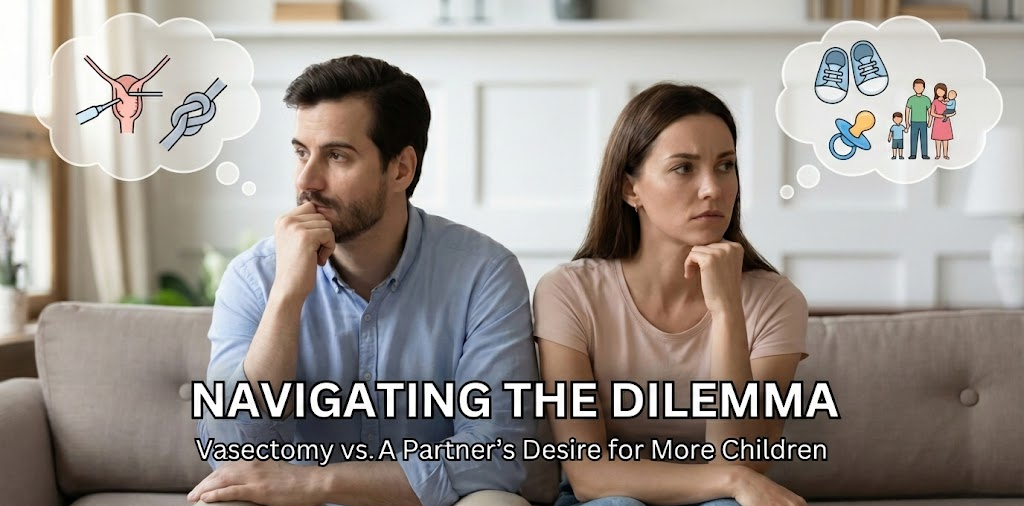
Few relationship conflicts cut as deeply as disagreements about children. When one partner feels certain they are done and the other still longs for more, the tension is not just practical. It is emotional, existential, and often identity-shaking.
At the center of this dilemma lies a delicate balance: honoring male bodily autonomy while genuinely respecting a partner’s desire to grow the family. There is no quick fix, but there is a thoughtful, humane way forward.
Start With What Matters Most: Honest, Compassionate Communication
Every resolution begins with conversation, not persuasion.
If you are considering a vasectomy, it is essential to communicate why clearly and calmly. This is not about winning an argument. It is about letting your partner understand your internal reality. Maybe you feel complete with your current family. Maybe finances, health, energy, or emotional capacity are weighing heavily on you. Whatever your reasons, speak them plainly and without defensiveness.
At the same time, listen deeply to your partner. Her desire for more children may come from a place of fulfillment, legacy, emotional longing, or even unspoken fears about loss or regret. Resist the urge to minimize or “logic away” her feelings. Validation does not mean agreement. It means acknowledging that her emotions are real and worthy of respect.
Avoid assumptions. Ask open-ended questions. Choose a quiet, distraction-free moment. These conversations deserve space and presence.
Look Beneath the Surface of the Desire
Conflicts about reproduction are rarely just about numbers.
For you, the desire for a vasectomy may stem from exhaustion, anxiety about the future, financial responsibility, health concerns, or a deep sense that your family already feels whole. It is worth asking yourself whether there are fears beneath the certainty. Fear of overwhelm. Fear of repeating difficult experiences. Fear of losing yourself.
For your partner, wanting more children may symbolize something far deeper than another pregnancy. It might represent emotional completion, a vision of family life she has held for years, or even unresolved grief about the children she imagined but does not yet have. Understanding these roots helps shift the conversation from “who is right” to “what is really being asked for.”
Explore Possibilities Without Pressure
Once both perspectives are fully on the table, the next step is exploration rather than decision-making.
Some couples benefit from time. Agreeing to revisit the conversation after six months or a year can lower emotional intensity and allow clarity to emerge naturally.
Others explore alternative paths to caregiving, such as adoption or foster care. These options are not compromises in the traditional sense. They require genuine enthusiasm and commitment from both partners, but for some, they align values in unexpected ways.
In rare cases, a middle ground on family size may exist, but this should never come from obligation or fear of loss. A child should never be the result of reluctant compromise.
Some couples consider sperm freezing as a way to keep future options open. While this does not change the immediate desire for a vasectomy, it can soften the sense of finality. Still, this option must align with your sense of autonomy and integrity.
Professional support can be invaluable here. Individual counseling helps clarify personal motivations, while couples counseling creates a structured space where both partners can feel heard without escalation.
Bodily Autonomy Still Matters
It is crucial to say this clearly: no one has the right to pressure you into a medical decision about your body.
Bodily autonomy is not selfish. It is foundational. A vasectomy is a deeply personal choice tied to health, identity, and long-term wellbeing.
That said, autonomy within a partnership does not mean isolation. Decisions made without empathy or dialogue can fracture trust. The goal is not to surrender your autonomy, but to exercise it with care, transparency, and respect for the emotional impact on your partner.
When No Compromise Exists
Sometimes, despite love and effort, there is no shared path forward.
If having more children is a non-negotiable truth for your partner, and being done with children is a non-negotiable truth for you, the conflict is not about stubbornness. It is about fundamentally different life visions.
Acknowledging this is heartbreaking. It may force painful questions about long-term compatibility. But avoiding these questions does not make them disappear. Honest reckoning, though difficult, is often kinder than silent resentment.
A Final Thought
This dilemma demands patience, courage, and emotional maturity. There are no villains here, only two people trying to honor their truths without losing each other.
The healthiest path forward is one rooted in clarity: clearly stating your needs, deeply hearing your partner’s, and working together toward a decision that respects both autonomy and love, even when the outcome is not easy.
Sometimes the bravest thing a couple can do is face the truth together, with compassion rather than control.
