
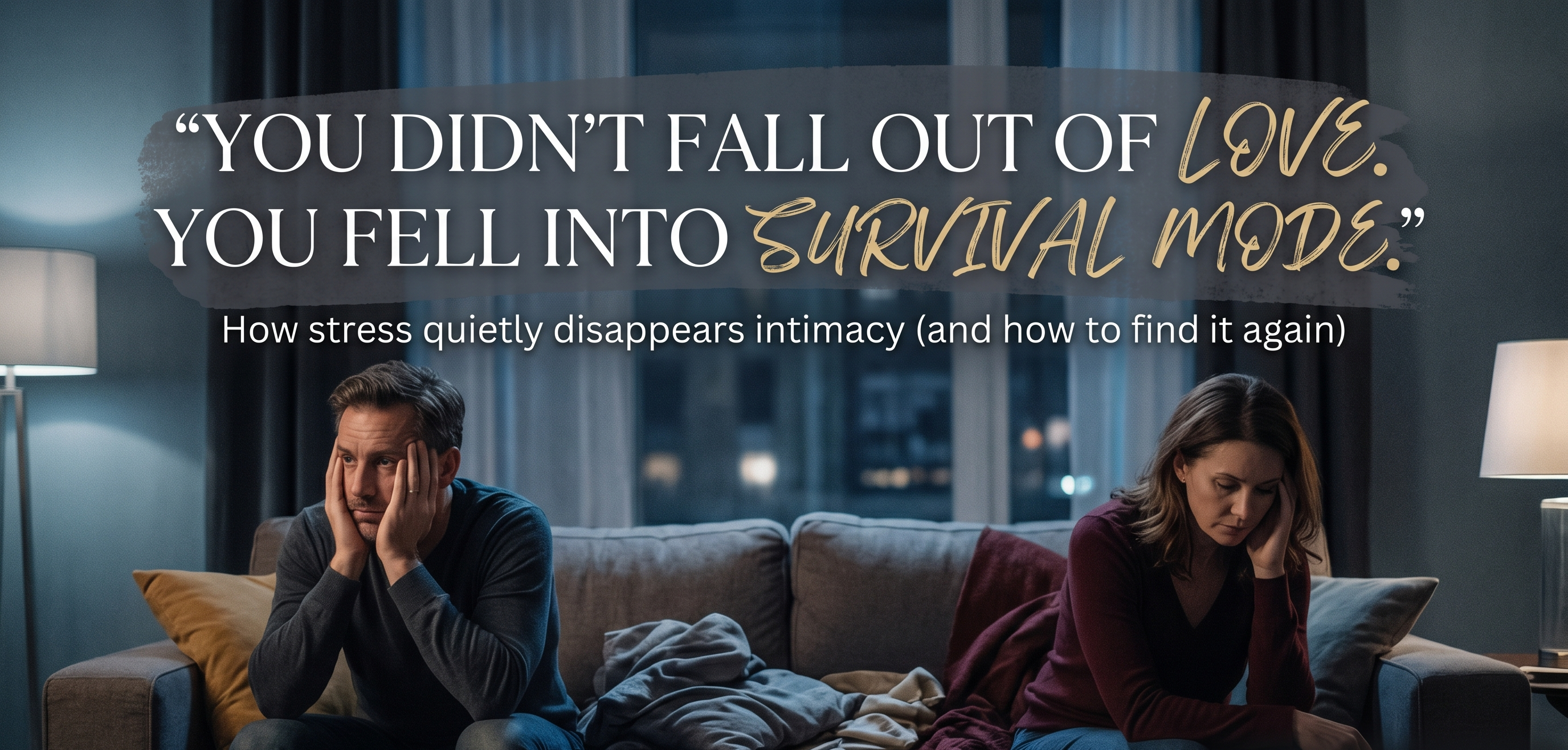
You didn’t fall out of love. You fell into survival mode.
If desire has quietly disappeared from your relationship—or from your own sense of self—stress is almost always somewhere in the story.
As a Licensed Professional Counselor Supervisor and Certified Clinical Sexologist, I see this pattern constantly: couples who are devoted to each other but completely disconnected physically and emotionally—not because anything is “wrong,” but because life became overwhelming and intimacy was the first thing to go.
Here’s what the research shows—and what you can do about it.
Stress Doesn’t Just Exhaust You. It Chemically Shuts Down Desire.
When your body is under chronic stress, cortisol levels rise. Cortisol is your primary stress hormone, and at elevated levels, it directly suppresses testosterone—the hormone responsible for sexual desire in both men and women.
Your nervous system, trying to protect you, deprioritizes pleasure and connection in favor of survival.
This means low libido during stressful periods isn’t a personal failure or a sign your relationship is broken. It’s biology—and understanding that is the first step toward change.
Three Patterns I See Most Often in Couples
1. The Avoidance Loop
One partner withdraws because initiating feels vulnerable. The other stops initiating because rejection feels unbearable. Nothing gets said. Distance grows.
2. The Performance Trap
Sex becomes goal-oriented instead of connection-focused. When expectations aren’t met, shame fills the gap—leading to more avoidance.
3. The Resentment Build
Unaddressed emotional disconnection turns into resentment. Often, intimacy issues are a symptom of deeper unmet emotional needs.
What Actually Helps
The good news: these patterns are workable. The approach I use is research-backed, practical, and focused on sustainable change—not quick fixes.
Mindfulness in Intimacy
Not abstract meditation, but real presence. Most couples are physically together but mentally elsewhere. Slowing down changes everything.
Direct, Low-Stakes Communication
Being able to express needs without shame or blame is one of the most powerful intimacy skills—and it’s learnable.
Understanding Your Own Body
Sexual self-awareness is foundational. You can’t communicate what you haven’t explored yourself.
Body Acceptance
Body shame blocks intimacy. Learning to experience your body as a source of connection—not judgment—is transformative.
When to Seek Support
- Desire has been absent for months and talking about it feels impossible
- Past experiences (infidelity, trauma, major transitions) still affect your relationship
- Sexual thoughts or behaviors feel distressing or out of control
- You want deeper connection but don’t know how to get there
You don’t have to wait until things reach a crisis point.
Ready to Take the First Step?
I work virtually with individuals and couples navigating intimacy, desire, infidelity recovery, and sexual concerns.
Erin A. Alexander is a Licensed Professional Counselor Supervisor (LPC-S) and Certified Clinical Sexologist (#18193). She works with couples, individuals, and military populations on intimacy, relationship recovery, and sexual wellness.
