
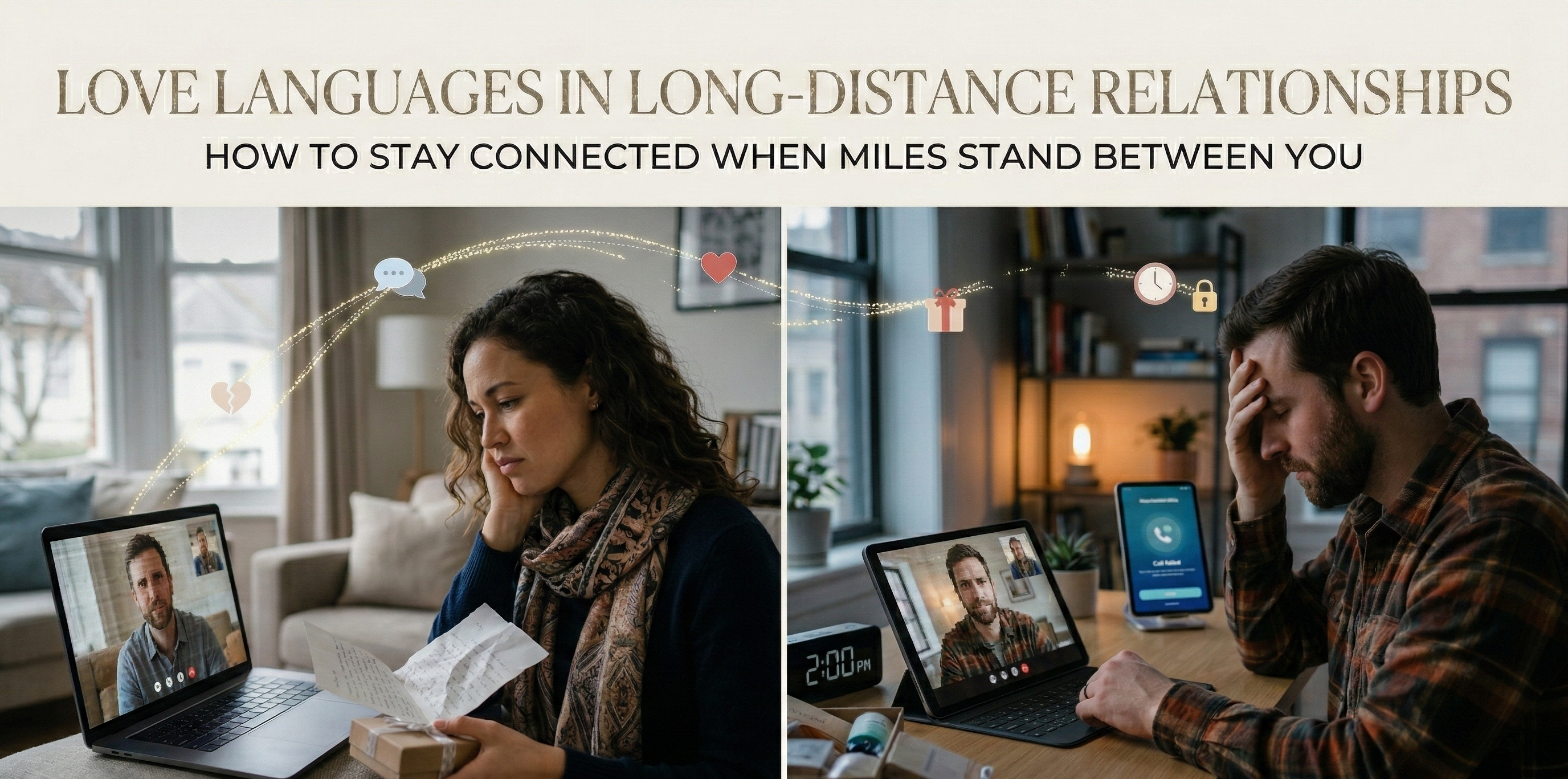
Long-distance relationships don’t fail because of the miles. They fail because of the silence that fills them.
When you can’t reach across the couch to squeeze your partner’s hand, or leave a sticky note on the bathroom mirror, or bring home their favorite takeout after a hard day, how do you make love feel real? How do you make your partner feel genuinely chosen, not just verbally reassured?
The answer, more often than not, comes down to love languages, and whether both partners are speaking them fluently across the distance.
As a Licensed Professional Counselor and Clinical Sexologist who works extensively with couples navigating separation (including military couples), I see this dynamic play out constantly. Today, I want to break it down in a way that’s actually useful, not just theoretical.
What Are Love Languages, and Why Do They Matter More in LDRs?
Developed by Dr. Gary Chapman, the five love languages describe the primary ways people give and receive emotional love:
- Words of Affirmation — verbal expressions of love, encouragement, and appreciation
- Acts of Service — doing things that make your partner’s life easier
- Receiving Gifts — thoughtful, tangible symbols of love and care
- Quality Time — undivided, intentional time and attention
- Physical Touch — physical closeness, affection, and intimacy
In a relationship where partners share the same space, misaligned love languages are inconvenient. In a long-distance relationship, they can feel devastating.
If your partner’s primary love language is Physical Touch and you’ve been apart for two months, no number of “I love you” texts will fully fill that tank, no matter how sincere they are. Understanding this isn’t an indictment of your effort; it’s a roadmap for where to direct it.
A Real LDR: When Love Languages Collide Across Time Zones
I recently worked with a couple, let’s call them Laura and Camilla, who illustrate this beautifully.
Laura, in her late twenties, is an active-duty Air Force service member stationed in Florida. Camilla, mid-twenties, is grinding through law school in New York City. Three years into their relationship, they share deep values and genuine commitment. But their careers have placed them on opposite sides of the country, and the stress of that separation was starting to show.
Here’s where it got interesting: their love languages were almost perfectly mismatched.
Camilla’s primary love language is Physical Touch. She thrives on hugs, on being held, on the quiet physical closeness that LDRs make impossible. Without it, she doesn’t just feel lonely, she starts to feel invisible, even when Laura is doing everything right.
Laura’s primary love language is Receiving Gifts. For her, a thoughtful, tangible gesture, a package in the mail, a meal delivered to her base, something that says I thought about you specifically, communicates love in a way that words alone can’t.
Neither of them was doing anything wrong. They were each expressing love in the way that felt most natural to them. But without intentionality, they kept pouring love into a cup that couldn’t hold it.
Bridging the Physical Touch Gap Across Distance
For a Physical Touch person, long-distance can feel like a prolonged drought. The solution isn’t to eliminate the need, it’s to get creative about how it’s met.
Here’s what worked for Laura and Camilla, and what I recommend to similar couples:
Send something that carries physical presence. Laura mailed Camilla one of her worn hoodies. The scent, the weight, the tangibility of it provided something no FaceTime call could: a sensory stand-in for her actual presence. This isn’t a small thing. Touch-oriented people are deeply tied to sensory input, and giving them something physical to hold matters enormously.
Create touch rituals on video calls. Laura and Camilla developed a habit of pressing their hands to the camera at the same time during calls, a small gesture that sounds simple but became one of their most meaningful rituals. Shared rituals are anchors. They signal: we have something that belongs only to us.
Make gifts serve double duty. Here’s a move I love: Laura bought Camilla a weighted blanket and told her, “This is me hugging you when I can’t be there.” She took her own love language (gifts) and translated it directly into Camilla’s (physical touch). That’s advanced love language fluency, and it worked.
Honoring the Gifts Love Language From Afar
For someone like Laura, whose love language is Receiving Gifts, the gift itself isn’t really the point. The point is the message behind the gift: you thought about me. You prioritized me. I crossed your mind even when life was demanding everything from you.
Distance actually makes this love language harder, not because gifts are impossible to send, but because the spontaneity disappears. In shared life, small gifts happen organically. In an LDR, every gesture requires planning.
That planning, it turns out, is part of what makes it meaningful.
Coordinate deliveries. Camilla would occasionally order Laura’s favorite coffee or lunch to be delivered to her base on a random workday—no special occasion, no explanation other than I was thinking about you. For Laura, receiving that in the middle of a demanding military schedule communicated more than a long conversation could.
Create personalized, non-physical gifts. Camilla compiled playlists tied to specific memories, the road trip they took, the running joke they shared, the first song that played on their first date. She created digital art rooted in their relationship. These weren’t expensive. They were time-expensive, which is what actually signals love in this language.
Write real letters. Physical mail still hits differently. Camilla sent handwritten letters describing specific things she admired about Laura’s service, her discipline, her sacrifice, the specific ways her dedication showed up. Laura could keep them. Return to them. That permanence matters to a Gifts person in a way it wouldn’t to someone else.
Quality Time in an LDR: It Has to Be Intentional
Long-distance couples often make the mistake of thinking any call counts as quality time. It doesn’t.
A call where both partners are half-present, one checking email, one cooking, is connection maintenance at best. Real quality time in an LDR requires the same undivided attention it would require in person.
For Laura and Camilla, this meant scheduled, non-negotiable virtual dates. Not passive background calls. Active, shared experiences:
- Cooking the same meal simultaneously on video chat
- Watching a movie with synchronized play buttons and texting reactions in real time
- Playing an online game together
- Taking a virtual “walk” with phone cameras on during their respective evening routines
The structure feels unromantic at first. But in an LDR, structure is what makes romance possible. You can’t stumble into quality time when you’re three time zones apart. You have to build it deliberately.
Maintaining a Healthy Sex Life Across Distance
This is the part most relationship content skips, so let me say it plainly: your sexual connection matters, and it doesn’t have to disappear just because you’re apart.
What does have to change is how you approach it.
For Laura and Camilla, this meant scheduling dedicated intimacy time, private, protected space on the calendar where the only agenda was their sexual and sensual connection. Phone calls. Video sessions. Conversations about desire, fantasy, and what they wanted from each other when they were finally in the same room again.
This kind of intentional sexual communication does something important: it keeps desire active. When couples let sexual connection go dormant during separation, it often doesn’t just pick back up when they reunite. Resentment, disconnection, and awkwardness can fill that space instead.
A few principles that help:
Talk about it openly, without shame. Desire doesn’t disappear during separation, it just goes unexpressed. Give it a place in your relationship rather than hoping it survives on its own.
Be curious about each other’s inner life. Separation is actually a rare opportunity for deep verbal intimacy. You’re forced to talk about things you might take for granted in person. Use it.
Don’t wait for the “perfect” moment. Perfect conditions don’t exist in an LDR. You have to work with the conditions you have, tired, stressed, in different time zones, and choose connection anyway.
The Deeper Truth About Long-Distance Relationships
Laura and Camilla’s relationship isn’t surviving despite the distance. In many ways, it’s growing because of what the distance requires.
They’ve had to name their needs explicitly. They’ve had to get creative and generous. They’ve had to build habits of intentionality that many same-city couples never develop, because proximity made it easy to coast.
That doesn’t make LDRs easy. It makes them, when navigated well, extraordinarily clarifying. You learn very quickly what the relationship is made of when convenience is removed from the equation.
If you’re in a long-distance relationship, whether due to military service, career demands, school, or circumstances beyond your control, the distance is not the threat. The silence is. The assumption that love alone will carry things forward without effort, communication, and creativity is.
It won’t. But intentionality will.
Working With Couples in Long-Distance and Military Relationships
I specialize in working with couples navigating exactly these dynamics—military separation, career-driven distance, same-sex couples, and the intimacy challenges that come with all of them.
My practice is fully virtual, which means geography is never a barrier to getting support.
If you’re ready to build something that holds up across any distance, I’d love to talk.
👉 Schedule a consultation with Erin A. Alexander, LPC-S
📞 425-666-9152
📧 erin@brighterfutureea.com
Frequently Asked Questions: Love Languages and Long-Distance Relationships
Can a long-distance relationship work long-term?
Yes, but not passively. LDRs that thrive do so because both partners treat the relationship as an active, ongoing project, not something that will sustain itself while life happens around it.
What’s the hardest love language to maintain in an LDR?
Physical Touch is consistently the most challenging, because it can’t be directly replicated. But it can be honored through creative, sensory substitutes—which, as Laura and Camilla’s story shows, can be surprisingly powerful.
How do you figure out your partner’s love language?
Start by paying attention to what they complain about most—you never hold my hand anymore points to Physical Touch. You never surprise me points to Gifts. You can also simply ask, or take the official love languages quiz together.
Is it normal for intimacy to decrease in LDRs?
It’s common, but it’s not inevitable. Couples who actively prioritize and schedule intimate connection tend to maintain much stronger sexual bonds through separation than those who assume it will sort itself out.
Should we work with a therapist if we’re in an LDR?
A therapist can be especially valuable in an LDR because communication has to carry so much weight. Having a skilled third party help you identify patterns, name needs, and build concrete strategies can prevent small disconnections from growing into major ruptures.
Erin A. Alexander, LPC-S, is a Licensed Professional Counselor Supervisor and Certified Clinical Sexologist. She specializes in couples therapy, military relationships, infidelity recovery, sexual concerns, and intimacy challenges. Her practice is fully virtual.
