
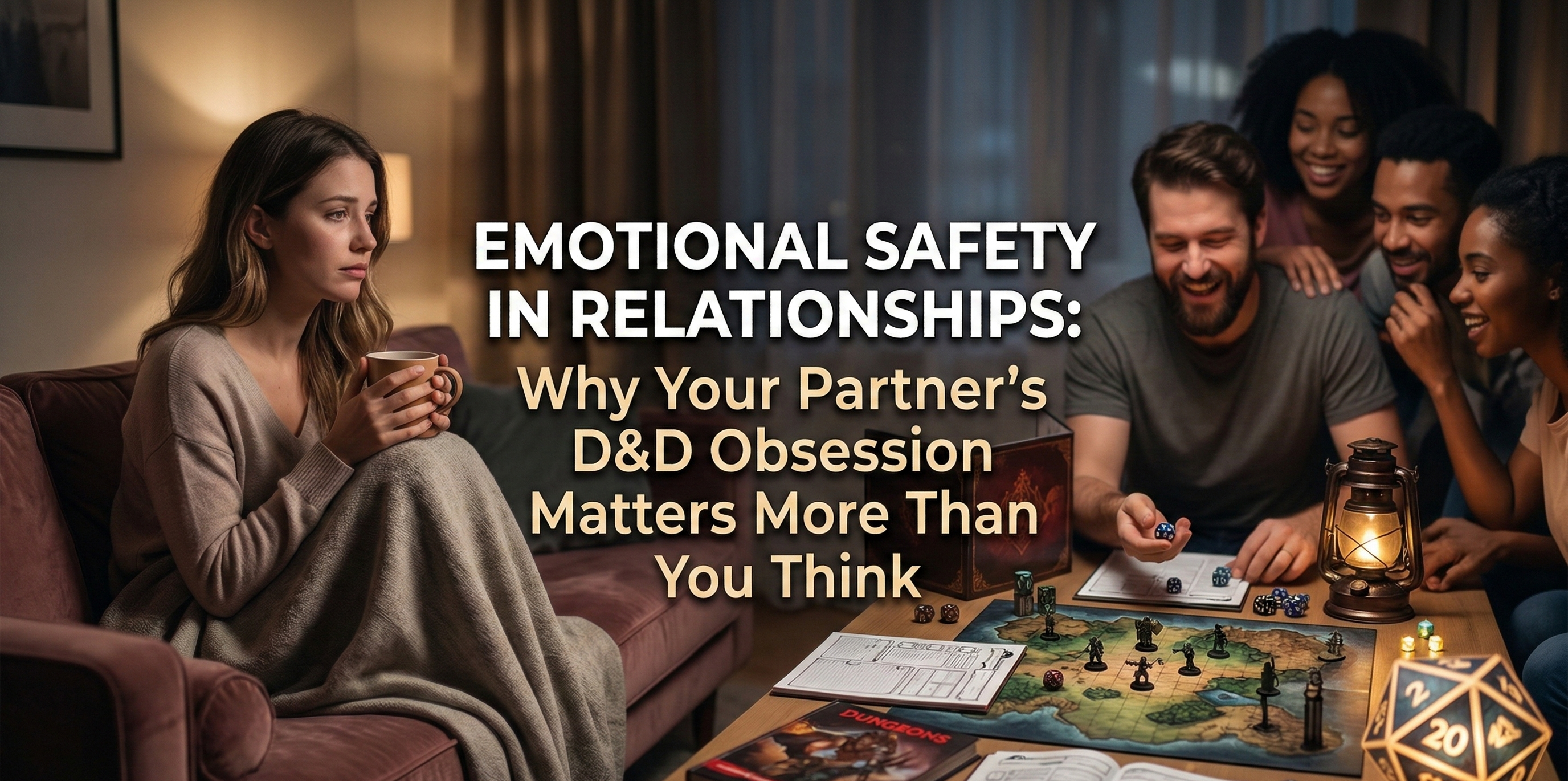
A sexologist’s guide to creating safe spaces, polyamory as needs fulfillment, and why not everything has to be about sex
By Ms. Erin Alexander, Clinical Sexologist
What Is Emotional Safety, Actually?
Hello, darlings. Ms. Erin here, your friendly neighborhood clinical sexologist and professional defender of people’s right to have hobbies that aren’t immediately sexy or relationship-enhancing.
Today we’re talking about emotional safety in relationships, the foundation that makes everything else (including great sex, by the way) actually possible.
And we’re going to discuss something that makes a lot of people uncomfortable: polyamory as a legitimate framework for needs fulfillment.
But first, let’s define what we’re even talking about.
Emotional Safety Is Not:
- Never disagreeing or having conflict
- Always feeling happy and comfortable
- Your partner reading your mind
- Constant validation and reassurance
- Having all your needs met by one person at all times
Emotional Safety IS:
A psychological container where you can be genuinely vulnerable without fear of judgment, ridicule, punishment, or abandonment.
It’s the feeling that you can:
- Express difficult emotions without being dismissed
- Share your authentic desires without being shamed
- Make mistakes without catastrophic relationship consequences
- Be fully yourself, including the weird, non-sexy parts
Think of it like this: Emotional safety is the relationship equivalent of a really good safety net. It doesn’t prevent you from falling (conflicts happen, life happens), but it ensures that when you do fall, you won’t be destroyed.
The Foundation: How to Actually Create Emotional Safety
Creating emotional safety isn’t about grand gestures or perfect communication. It’s about consistent, reliable behaviors that build trust over time.
Element #1: Unconditional Positive Regard
What it is: Approaching your partner’s revelations—even difficult, uncomfortable, or surprising ones—with non-judgmental acceptance.
What it looks like in practice:
Your partner reveals something vulnerable:
- ❌ “That’s weird. Why would you want that?”
- ❌ “You’re overthinking this.”
- ❌ “That’s a stupid thing to be upset about.”
- ✅ “Thank you for trusting me with that. Tell me more about how you’re feeling.”
My framework: You don’t have to agree with, like, or understand everything your partner feels or wants. But you do need to accept that their feelings are real and valid to them.
The distinction:
Unconditional positive regard ≠ agreeing with everything
Unconditional positive regard = accepting that your partner’s inner experience is real and worthy of respect
Example:
Partner: “I’m feeling really insecure about your friendship with Alex.”
Unconditional positive regard: “I hear that you’re feeling insecure. That must be uncomfortable. Let’s talk about what’s triggering that and what would help you feel safer.”
NOT unconditional positive regard: “You’re being ridiculous. Alex and I are just friends. You need to get over this.”
Element #2: Active and Empathetic Listening
What it is: Actually focusing on understanding your partner’s internal experience rather than formulating your rebuttal, defense, or solution while they’re talking.
The problem: Most of us listen to respond, not to understand.
While our partner is talking, we’re:
- Planning our counterargument
- Thinking about how this affects us
- Preparing our defense
- Formulating the perfect solution
What to do instead:
Listen to understand:
- What are they actually saying?
- What emotion is underneath the words?
- What do they need from me right now?
Reflect back:
- “What I’m hearing is that you feel [emotion] because [situation]. Is that right?”
- “It sounds like you need [need]. Am I understanding correctly?”
Ask clarifying questions:
- “When you say [X], what does that mean for you?”
- “Help me understand what you need from me in this conversation.”
My clinical observation: 80% of relationship conflicts would resolve or de-escalate significantly if both people focused on understanding before defending.
Element #3: Predictability and Reliability
What it is: Consistently demonstrating that your relationship can withstand conflict, emotional intensity, and difficult conversations without falling apart.
Why this matters: People can’t be vulnerable if they’re terrified that one wrong move will end the relationship.
What it looks like:
After a conflict, you:
- Still show up
- Still express affection
- Still demonstrate commitment
- Process the conflict and repair
You don’t:
- Threaten to leave during arguments
- Withdraw affection as punishment
- Give silent treatment for days
- Make your partner beg for reconciliation
The pattern you’re building: “We can fight. We can disagree. We can have hard conversations. And we’re still okay. The relationship is stable.”
This predictability creates safety for vulnerability.
If your partner knows that expressing a difficult feeling won’t result in you leaving, punishing them, or withdrawing love, they’re infinitely more likely to actually tell you what’s going on inside.
Polyamory as a Framework for Comprehensive Needs Fulfillment
Okay, here’s where I might lose some of you, and I need you to stay with me.
Polyamory, ethical, consensual non-monogamy where people have multiple loving relationships simultaneously—is often dismissed as “just wanting to sleep around” or “being greedy.”
But from a clinical sexology perspective, polyamory offers a genuinely unique framework for meeting emotional, physical, intellectual, and social needs in ways that can actually increase relationship safety and fulfillment.
(Deep breath. Let’s talk about this like adults.)
What Polyamory Actually Offers
I’m not here to convert anyone to polyamory. Monogamy works beautifully for many people. But I am here to challenge the idea that polyamory is inherently less safe, less committed, or less legitimate than monogamy.
In fact, done ethically, polyamory can create profound safety through several mechanisms:
Benefit #1: Diversified Needs Fulfillment
The monogamy challenge: One person is expected to fulfill all your needs—emotional support, intellectual stimulation, sexual compatibility, shared hobbies, social connection, adventure partnership, domestic compatibility.
That’s a lot of pressure.
The polyamory framework: Different relationships can fulfill different needs.
Example:
- Partner A: Deep emotional intimacy, shared love of quiet evenings, amazing sexual chemistry
- Partner B: Intellectual debate partner, shared passion for rock climbing, stimulating conversations about philosophy
- Partner C: Creative collaboration, shared artistic pursuits, playful dynamic
Impact on safety: Reduces the burden on any single partner to be everything. Prevents resentment when one person can’t fulfill a specific need. Makes the relationship less fragile.
My observation: In healthy polyamorous structures, people often feel safer because they’re not desperately clinging to one person as their entire source of fulfillment.
Benefit #2: Increased Self-Knowledge
What happens: Navigating multiple relationships requires:
- Heightened self-awareness about your own needs
- Clearer communication about boundaries
- Honest examination of jealousy, insecurity, and attachment
- Articulation of desires you might ignore in monogamy
Impact on safety: This forced clarity and self-examination creates authenticity in all relationships. You become more genuinely known because you’ve done the work to know yourself.
Example:
Monogamy: “I’m fine with whatever you want to do.” (But you’re not fine, you just don’t know what you actually need.)
Polyamory: “I need one evening per week of dedicated one-on-one time to feel connected. I need advance notice about schedule changes. I need to process jealousy when it comes up rather than suppress it.”
That level of clarity benefits everyone.
Benefit #3: Mandatory Transparency and Openness
The requirement: Ethical polyamory requires radical honesty about:
- Feelings (including difficult ones like jealousy or insecurity)
- Time and scheduling
- Other relationships and their progression
- Changing needs or desires
- Sexual health and safety
You can’t hide things and maintain ethical polyamory. (If you’re hiding, you’re cheating, not practicing polyamory.)
Impact on safety: This mandatory transparency inherently builds trust. When honesty is structurally required, it becomes safer to express difficult emotions or new desires because that’s literally the agreement.
My framework: Polyamory doesn’t eliminate jealousy, insecurity, or conflict. But it requires you to talk about them instead of pretending they don’t exist.
Benefit #4: Multiple Sources of Support
What it looks like: When you have multiple loving relationships:
- One bad day with Partner A doesn’t feel catastrophic (you have other sources of connection)
- You can express complex or difficult needs without the entire stability of your world resting on one person’s acceptance
- You have built-in perspective (other partners can offer different viewpoints)
Impact on safety: Paradoxically, having multiple partners can make you feel more secure because your emotional wellbeing isn’t entirely dependent on one person’s mood, availability, or capacity.
The Magic of Compersion (Or: Taking Joy in Your Partner’s Joy)
Here’s a concept that bends most people’s brains: compersion.
Compersion: The experience of taking joy, happiness, or satisfaction in your partner’s happiness—even when that happiness comes from another relationship.
In practice:
Your partner has an amazing date with someone else. They come home glowing, happy, fulfilled.
Jealousy response: “They’re happy with someone who isn’t me. That means I’m not enough. I’m being replaced.”
Compersion response: “Look how happy they are! I love seeing them fulfilled and joyful, even though I’m not the source of it in this moment.”
Why this matters for safety:
Compersion fundamentally reframes a partner’s fulfillment outside the relationship as a positive, shared outcome rather than a threat.
The result: Your partner feels safer pursuing connections, hobbies, friendships, and relationships that bring them joy because you’re genuinely happy when they’re happy, not threatened by it.
Important note: Compersion isn’t mandatory in polyamory, and jealousy still happens. But cultivating the capacity for compersion, even in small moments, creates profound emotional security.
My take: Compersion is actually possible in monogamy too. It’s the feeling you get when your partner has an amazing day at work, makes a new friend, or finds a hobby they love, and you’re genuinely happy for them even though you’re not directly involved.
Polyamory just extends that feeling to romantic/sexual connections.
Respecting Non-Sexual Needs: Your Partner Is More Than Your Sex Life
Here’s something I see constantly in my clinical practice: the tendency to sexualize or dismiss a partner’s needs, hobbies, or desires that aren’t explicitly sexual.
This is a huge problem for relationship safety.
The Pattern:
Partner has a non-sexual interest:
- Deep friendship with someone
- Career ambitions that require time and focus
- Solitary creative pursuit (writing, painting, gaming)
- Intellectual hobby (learning a language, studying philosophy)
Problematic response:
- “Is that friend attractive to you?”
- “This hobby takes time away from us.”
- “Why do you need that when you have me?”
- Trying to make everything sexual (“Ooh, tell me about your work presentation… does it turn you on?”)
Why this is a problem: It signals that the only parts of your partner that matter to you are the parts that relate to you or serve the relationship.
That’s not safety. That’s reduction.
Decoupling Need from Sexual Response
The skill: Appreciating your partner’s non-sexual passions for their intrinsic value to your partner’s wellbeing, not for how they benefit you or the relationship.
What this looks like:
Partner: “I’m really excited about this new project at work.”
Reductive response: “That’s nice. Are you still going to have time for date night?”
Respectful response: “Tell me about it! What makes this project exciting for you? How are you feeling about it?”
Partner: “I’m going to my friend’s house for game night Thursday.”
Sexualizing response: “Is anyone there you’re attracted to? Who’s going?”
Respectful response: “That sounds fun! What are you playing? I hope you have a great time.”
Partner: “I need a few hours alone this weekend to paint.”
Dismissive response: “Can’t you do that when I’m at work? We barely have time together as it is.”
Respectful response: “Absolutely. What time works best for you? I’ll make sure you have uninterrupted space.”
The Questions to Ask Instead
Replace:
- “Will that take time away from us?”
- “Is that person attractive?”
- “Why do you need that?”
With:
- “How does this make you feel?”
- “What fulfillment do you gain from this?”
- “What do you love about this activity/person/pursuit?”
Respecting Boundaries of Interest
The principle: Some things your partner does are purely for them. Not for the relationship. Not for you. For their own autonomous self.
And that’s not only okay, it’s essential.
Examples:
- Partner wants to discuss their job for emotional support, not as foreplay or to turn you on
- Partner has a friendship that’s just a friendship and doesn’t need to be analyzed
- Partner has a hobby that’s their personal thing and they don’t need to justify or share it
Your job: Maintain the frame they’re requesting. If they want support, give support. If they want to share joy, receive it. Don’t sexualize what isn’t meant to be sexual.
Recognizing Non-Productive Time as Essential
The cultural problem: We’re trained to view “productive” time as good and “non-productive” time as wasteful.
The reality: Your partner needs desire in a broad sense:
- Desire for solitude
- Desire for creative expression
- Desire for intellectual challenge
- Desire for community connection
- Desire to do absolutely nothing
These needs are essential for individual emotional regulation and must be respected as fundamentally important to the relationship’s health, even if they temporarily decrease availability for sexual engagement.
Example:
Your partner needs three hours on Saturday to just… exist. Read a book. Stare at the ceiling. Play video games. Whatever.
Reductive view: “That’s wasted time. We could be together.”
Healthy view: “That recharge time makes them a better, more present partner when we are together.”
Practical Applications: How to Actually Do This
For Monogamous Relationships:
1. Audit your assumptions:
- Do you expect your partner to fulfill all your needs?
- Do you get resentful when they can’t?
- Do you support their non-sexual interests genuinely?
2. Encourage independent fulfillment:
- Actively support their friendships, hobbies, solo time
- Don’t compete with their other sources of joy
- Celebrate when they find fulfillment outside the relationship
3. Practice compersion in small ways:
- Be genuinely happy when they have a great day without you
- Celebrate their wins even when you weren’t involved
- Support their growth even when it doesn’t directly benefit you
For Polyamorous Relationships:
1. Prioritize radical transparency:
- Share feelings even when they’re uncomfortable
- Communicate schedule changes clearly
- Process jealousy and insecurity together
2. Do the self-knowledge work:
- Know your actual needs and boundaries
- Articulate them clearly
- Revisit and adjust as you grow
3. Respect each relationship’s unique dynamic:
- Don’t compare partners or relationships
- Allow each connection to be what it naturally is
- Celebrate differences rather than forcing sameness
For Everyone:
1. Create predictable safety:
- Show up consistently after conflicts
- Don’t threaten the relationship during arguments
- Repair when you mess up
2. Listen to understand, not to defend:
- Pause before responding
- Reflect back what you hear
- Ask clarifying questions
3. Honor your partner’s whole self:
- Support their non-sexual needs and interests
- Don’t reduce them to what they provide you
- Celebrate their complexity
The Bottom Line: Safety Enables Everything Else
Here’s my final take as someone who spends their professional life helping people build healthy relationships:
Emotional safety is the foundation that makes everything else possible—great sex, deep intimacy, authentic connection, genuine growth.
And creating that safety requires:
- Unconditional positive regard for your partner’s inner experience
- Active listening without defensiveness
- Predictable reliability through conflict and intensity
- Respect for their whole self, including the parts that have nothing to do with you
Whether you’re monogamous or polyamorous:
The core principle is the same: Your partner is a complex, multifaceted human being with needs, desires, and interests that extend far beyond your relationship.
Supporting that complexity is an act of deep, non-sexual love and commitment.
It’s saying: “I want you to be fully yourself, even when that self doesn’t directly serve me or the relationship. I celebrate your joy, your growth, your friendships, your solitude, your weird hobbies, your career ambitions, your need for space.”
That’s safety.
And when your partner feels genuinely safe to be their full, authentic, complex self with you?
Everything else, including the sexual connection, becomes infinitely better.
You’ve got this.
—Ms. Erin
This article is for informational purposes only and does not constitute medical or therapeutic advice.
