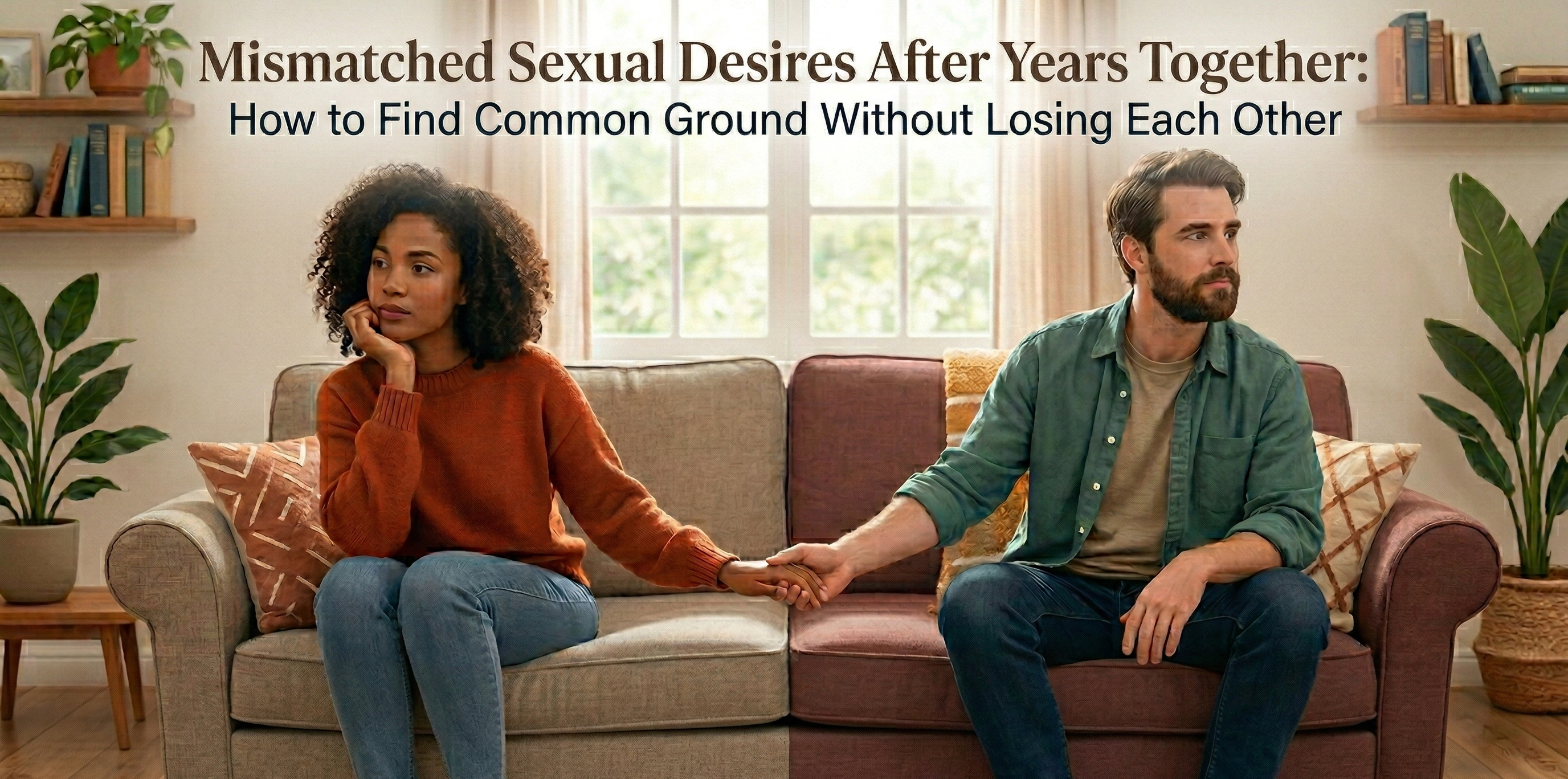
Thirteen years is a long time to build something together. It’s long enough to know each other’s coffee orders, finish each other’s sentences, and navigate every kind of hard thing life can throw at a couple.
It’s also long enough for two people to quietly grow in different directions sexually, and not know what to do about it.
This is one of the most common and least talked-about struggles I see in my work as a clinical sexologist: not couples who have fallen out of love, but couples who genuinely love each other and have completely different sexual landscapes. One partner is content. The other is quietly craving something more, more novelty, more exploration, specific fantasies or fetishes that feel like a core part of who they are.
The challenge isn’t a lack of love. It’s a mismatch in sexual curiosity. And those are very different problems with very different solutions.
The Difference Between Mismatched Libido and Mismatched Desire
When most people hear “sexual mismatch,” they think of frequency, one partner wants sex more often than the other. That’s a libido gap, and it’s real and worth addressing.
But what I see just as often, and what gets far less attention, is a curiosity gap: two people who may want sex equally often, but want fundamentally different kinds of sexual experience.
One partner finds deep satisfaction in the familiar. The intimacy is comfortable, warm, and reliably good. They’re not bored; they’re content.
The other partner’s inner sexual world is more expansive. They’re drawn to specific fantasies, fetishes, power dynamics, or experiences that their current relationship doesn’t include. This isn’t a phase. It’s not a criticism of their partner. It’s simply how they’re wired, and it’s not going away.
When the second partner tries to name this, it often lands hard. The content partner hears: what we have isn’t enough for you. The curious partner means: there’s a part of me I’ve never been able to share with you.
This communication failure, where desire is heard as rejection, is where couples get stuck.
A Real Couple: Thirteen Years In, Standing at a Crossroads
I recently worked with a couple I’ll call Heather and Gerald. Thirteen years together. Solid friendship. Genuine love. And a sexual gap that had grown quietly for years until it couldn’t be ignored anymore.
Gerald was satisfied. Their sex life felt good to him, comfortable, reliable, theirs. He didn’t feel anything was missing.
Heather was struggling. She loved Gerald deeply, but her sexual self was craving growth, specific fetishes, particular fantasies, experiences that spoke to a psychological dimension of her arousal that their current dynamic didn’t reach. She’d even mentioned, carefully, the idea of consensual nonmonogamy (CNM) as a possibility.
Gerald heard that as a threat. An exit ramp. A signal that she was preparing to leave, or that he simply wasn’t enough.
Neither reading was correct. But they couldn’t get past it on their own.
What Gerald Needed to Understand First
Before any practical solutions could work, Gerald needed to shift one fundamental thing: how he was interpreting Heather’s desires.
He was reading her curiosity as a verdict on him. It wasn’t. It was information about her.
Heather’s desire for sexual exploration wasn’t a statement about Gerald’s performance or desirability. It was a statement about her own psychological wiring, one that existed before she met him and would exist regardless of who she was with. Her wanting to explore didn’t mean she wanted to leave. It meant she wanted to be fully known by someone she trusted.
Once Gerald could hear it that way, as an invitation into deeper intimacy rather than a rejection of what they had, the entire conversation changed.
The reframe that matters: Your partner’s unexpressed desires aren’t a threat to your relationship. They’re a part of your partner that’s been invisible. The relationship gets more intimate when they become visible, not less.
Practical Strategies for Couples Navigating a Desire Gap
Once both partners are genuinely open to problem-solving, there’s actually a lot of creative room to work with. Here are the approaches that work best in my practice:
1. Start With Fantasy Before Activity
For a partner who’s resistant to unfamiliar sexual territory, jumping straight to action can feel overwhelming. But fantasy is lower stakes, and it gets at the psychological core of what the more curious partner is actually seeking.
What this looks like in practice: Set aside dedicated time, even 15 minutes a week, for what I call “Fantasy Hour.” The exploring partner narrates a scenario that excites them. The other partner listens, asks questions, engages emotionally and intellectually. No physical participation required.
This does something important: it gives the curious partner the experience of being seen in their desire, which is often what they’re actually hungry for. And it gives the reluctant partner a low-pressure on-ramp into their partner’s inner world.
2. The Structured Exploration List
When one partner wants to try specific things and the other feels overwhelmed by the breadth of possibilities, a structured approach removes the overwhelm.
Here’s how it works: the exploring partner identifies three specific, contained things they’d like to try, not an open-ended list, not a conversation about everything all at once. Just three concrete items.
The other partner has full veto power over all three. But they commit to genuinely agreeing to try at least one.
This works because it gives the reluctant partner control, which is usually what’s underneath the resistance. It’s not that they don’t want to please their partner—it’s that they feel like they’re being asked to sign a blank check. The structured list is a specific, bounded ask instead.
If the agreed-upon item goes reasonably well, it expands the couple’s shared comfort zone organically. Progress builds on progress.
3. Supported Solo Exploration
Some desires are deeply personal, specific fetishes or arousal patterns that one partner simply can’t or won’t engage with. In those cases, the goal isn’t to force participation. It’s to create space for the exploring partner to engage with those desires privately, with the other partner’s knowledge and explicit support.
This is not infidelity. This is not the beginning of nonmonogamy. It is a conscious agreement that one partner’s sexual self includes territory the other doesn’t share and that’s okay.
The critical piece is the conversation that makes it explicit. It requires trust, transparency, and a shared understanding that solo exploration doesn’t diminish the primary relationship. It supplements it.
4. Revisiting Consensual Nonmonogamy Carefully
CNM came up early in Heather and Gerald’s conversations, and it landed like a grenade. Gerald heard it as Heather wanting out. Heather meant something far more nuanced.
If CNM re-enters a couple’s conversation and for many couples with significant desire gaps, it does, it needs to be reintroduced with a lot of care and with very specific definitions.
CNM is not one thing. It exists on a wide spectrum:
Kink events and sex-positive spaces as observers. Attending together, without engaging with others, but allowing the curious partner to feel part of a broader community. This is often enough to provide the validation and sense of belonging that was driving the request in the first place.
Fantasy-based online exploration. Agreeing that one partner can engage in anonymous, non-physical fantasy roleplay or consume media related to their interests—with the other partner’s knowledge and consent.
Soft swapping or parallel play. The most structured and boundaried forms of partner interaction, well short of full CNM.
I want to be very direct here: do not attempt to navigate CNM without professional support. The stakes are too high and the emotional complexity too significant. CNM done poorly doesn’t just fail, it damages. CNM done well, with proper communication structures in place, can actually strengthen a relationship’s foundation.
If this is on the table for your relationship, bring a skilled therapist into that conversation before you make any decisions.
The Hardest Truth About Long-Term Sexual Compatibility
Here’s what I tell couples in this situation, and it’s not always easy to hear:
Compatibility isn’t static. It’s something you keep building.
The couple who met thirteen years ago had different needs, different levels of self-knowledge, different ideas about what they wanted from a sexual relationship. That’s not anyone’s failure. That’s just growth.
The question isn’t are we compatible? It’s are we both willing to keep negotiating who we are to each other?
Heather needs to feel fully seen, including the parts of her sexuality that are complex and specific and maybe unfamiliar to her partner. Gerald needs to feel safe, chosen, and not threatened by a part of Heather he doesn’t fully understand yet.
Neither of those needs is unreasonable. And meeting both of them requires exactly one thing: the willingness to keep talking, honestly and with care, even when it’s uncomfortable.
The couples who make it through a desire gap don’t do it by one partner quietly surrendering their needs or the other quietly tolerating something that scares them. They do it by building a communication container strong enough to hold both people’s full truth.
That container is what commitment actually is.
When to Bring in a Professional
If you’re reading this and recognizing your own relationship, I want to name something clearly: navigating a significant desire gap is genuinely hard work, and it’s okay to need support.
You might want to consider couples therapy if:
- Conversations about sexuality consistently escalate into conflict or shutdown
- One partner feels chronically unseen in their desires, and the other feels chronically threatened by them
- CNM or open relationship structures are on the table and you’re not sure how to approach them safely
- You’ve been circling this issue for months or years without meaningful progress
This is exactly the kind of work I do with couples. I specialize in sexual concerns, consensual nonmonogamy, kink-related issues, and the intimacy challenges that come with long-term relationships. My practice is fully virtual.
👉 Schedule a consultation with Erin A. Alexander, LPC-S
📞 425-666-9152
📧 erin@brighterfutureea.com
Frequently Asked Questions: Sexual Desire Gaps in Long-Term Relationships
Is it normal to have different sexual interests than your partner after many years?
Completely. People grow and change, and sexual curiosity evolves over time. A desire gap doesn’t mean you’re incompatible—it means you’re two real, fully developed people who need to have honest conversations.
My partner has fetishes I’m not interested in. Do I have to participate?
No. Consent is foundational, and no one should be pressured into sexual activity they’re not comfortable with. The goal is finding creative middle ground that honors both partners—not forcing participation. A therapist can help you find that middle ground.
What is consensual nonmonogamy, and is it right for us?
CNM is an umbrella term for relationship structures where both partners agree that one or both may have sexual or romantic connections outside the primary relationship. Whether it’s right for you depends entirely on both partners’ genuine, uncoerced willingness and a very strong communication foundation. It’s not a solution to a troubled relationship, it’s a structure that healthy relationships sometimes choose intentionally.
Can therapy really help with sexual incompatibility?
Yes, significantly. A clinical sexologist or sex-positive therapist can help couples articulate needs they’ve never put into words, navigate conversations that feel impossible alone, and build concrete agreements that honor both partners.
What if my partner thinks my desires are “just a phase”?
This dismissal, however well-intentioned, is one of the most painful things a partner can experience. Your desires are real and deserve to be taken seriously. A therapist can help your partner understand what those desires actually mean and why dismissing them doesn’t make them go away.
Erin A. Alexander, LPC-S, is a Licensed Professional Counselor Supervisor and Certified Clinical Sexologist. She specializes in couples therapy, sexual concerns, consensual nonmonogamy, kink-related issues, and intimacy challenges. Her practice is fully virtual.
📍 9110 N Loop 1604 W Ste 104, PMB 3025, San Antonio, TX 78249
📞 425-666-9152 | 📧 erin@brighterfutureea.com
🌐 loveandintimacybyerin.com
