
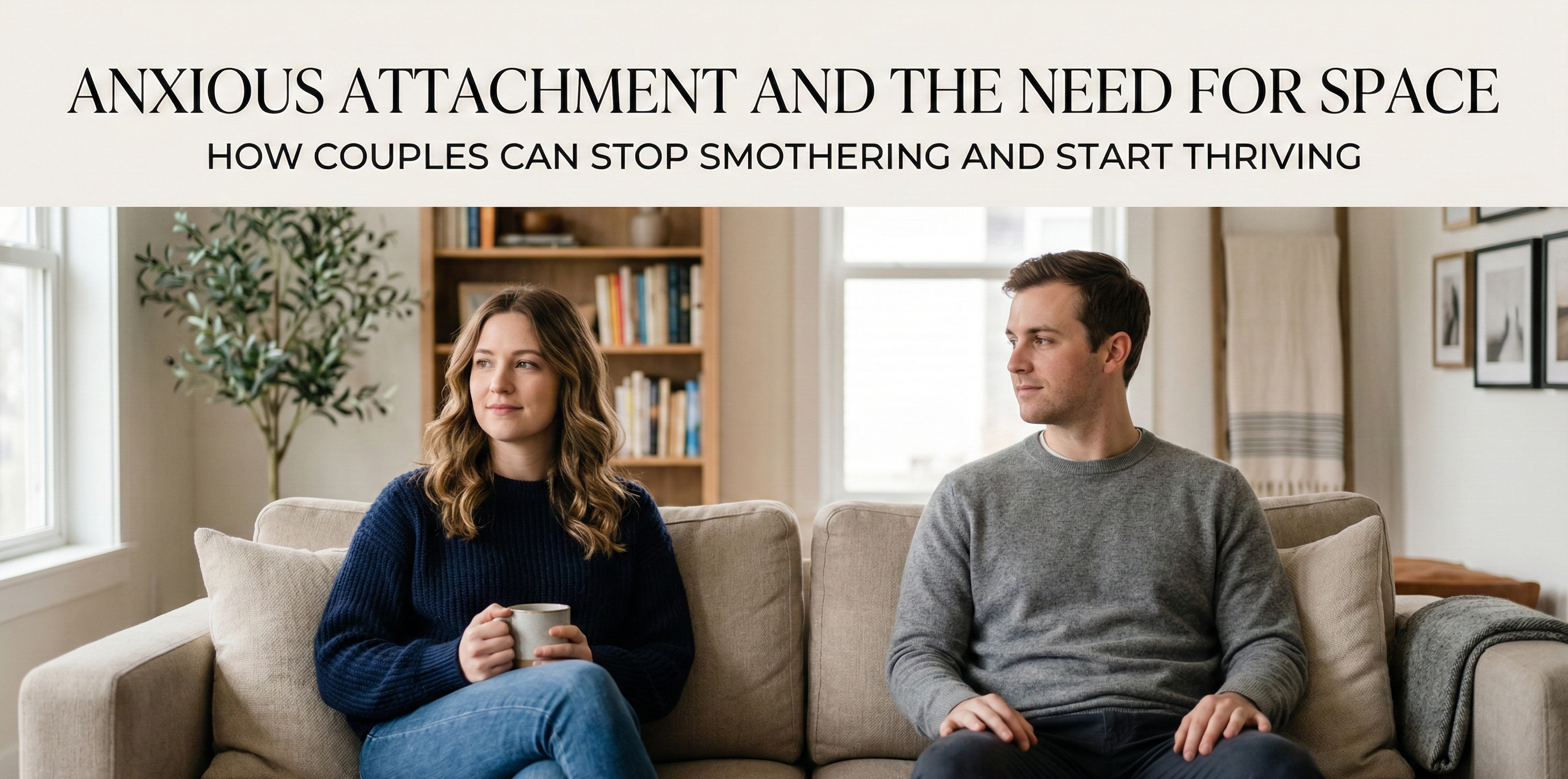
If you’ve ever felt like your partner’s love comes with an invisible leash, or if you are the one gripping the leash, you’re not alone. One of the most common struggles I see in my work as a Licensed Professional Counselor and Clinical Sexologist is the tension between anxious attachment and the very real human need for personal space.
This isn’t about one partner loving more than the other. It’s about how our brains are wired to seek safety, and what happens when two people’s wiring doesn’t quite match.
Let’s unpack it, with honesty, a little humor, and some practical tools you can actually use.
What Is Anxious Attachment, and Why Does It Drive a Need for Constant Closeness?
Attachment theory, pioneered by psychologist John Bowlby and expanded by researchers like Mary Ainsworth, describes the patterns we develop early in life for how we relate to others emotionally. These patterns follow us into our adult romantic relationships.
Anxious attachment develops when early caregiving was inconsistent, sometimes warm, sometimes unavailable. The result? A nervous system that is always scanning for signs of abandonment, always trying to close the gap between itself and the person it loves.
For someone with anxious attachment, a partner who needs alone time doesn’t register as “she’s recharging” it registers as “she’s leaving me.” That delayed text? A warning sign. That request for an hour of quiet? A rejection.
This is not a character flaw. It is a survival strategy that once made a lot of sense. But in adult relationships, it can create a cycle of clinging and withdrawing that exhausts both partners.
What Is Secure Attachment, and Why Does It Help?
A securely attached person tends to view their relationship as a home base: a safe place to return to, not a place you’re trapped inside. They’re comfortable with both closeness and independence. When conflict arises, their instinct is to collaborate, to find a solution that works for both people.
When a securely attached person is partnered with someone who has anxious attachment, the mismatch can create real friction. The secure partner interprets their need for space as completely normal. The anxious partner interprets that same space as a five-alarm emergency.
Neither is wrong. They’re just speaking different emotional languages.
The “Snuggle Swamp”: When Love Feels Like Smothering
I work with couples like this all the time. Let me paint you a picture.
Imagine a woman, let’s call her Samantha, who is under enormous work pressure. She needs quiet. She needs breathing room. She needs to read a book for 45 minutes without commentary.
Her partner, let’s call him Victor, is wired with anxious attachment. The moment Samantha retreats even slightly, his internal alarm goes off. He starts hovering. He’s in the kitchen while she cooks, offering unsolicited observations. He’s reorganizing the spice rack three feet away from her work call. He performs what I affectionately call a “full-body clamshell maneuver” in the bed at night.
Victor isn’t malicious. He isn’t controlling. He is scared. And his brain has decided that physical proximity is the only reliable antidote to fear.
But Samantha is drowning in love she doesn’t have room to breathe through.
This is what I call the Snuggle Swamp, and it’s more common than you’d think.
Why Personal Space Is Not a Threat to Your Relationship (It’s the Opposite)
Here’s the counterintuitive truth that anxious partners often need to hear: space is not distance. Space is oxygen.
When your partner asks for alone time, they are not pulling away from you. They are filling their tank so they have something to give you. A partner who never gets to recharge becomes resentful, exhausted, and emotionally unavailable, not because they stopped loving you, but because their resources ran dry.
Secure, lasting intimacy is built between two whole people, not two people fused together out of fear.
4 Research-Backed Strategies for Couples Navigating Anxious Attachment
1. Have the Explicit Conversation About Space Needs
This sounds obvious, but most couples never actually name it. The anxiously attached partner assumes closeness is always welcome. The other partner assumes their need for space is obviously communicated. Neither assumption is correct.
Samantha’s approach with Victor is a great model: “My tank is empty. I need an hour to recharge. From 7:30 to 8:30 p.m., I’m unavailable, please honor that bubble. From 8:30 to 9:30 p.m., I’m all yours.”
This works because it does two things at once: it clearly names the boundary and it directly reassures the anxious partner that connection is coming. The time limit matters enormously. “I need space” with no end point feels like abandonment. “I need space until 8:30, and then we reconnect” feels safe.
2. Try Parallel Play for Adults
One of the most underrated relationship tools is parallel presence, being in the same room, but each doing your own thing. No commentary. No intense eye contact through the kitchen doorway. Just coexisting.
For the anxiously attached partner, this satisfies the need for proximity. For the partner who needs solitude, it removes the pressure of active engagement. You’re together, but you’re not on top of each other.
This is particularly effective during high-stress periods when one partner is overwhelmed but the other is craving connection.
3. Create a Lighthearted “Space Signal”
Couples who can laugh together navigate conflict far better than those who can’t. I often suggest a code word or signal that the space-needing partner can use when they’re hitting their limit, before they hit the snapping point.
It could be anything silly. The absurdity of it actually helps, it reframes the moment from “I’m pushing you away” to “we have a system, and we’re using it.” The anxious partner hears the code word and knows: this isn’t rejection, this is our plan working.
4. Address the Underlying Anxiety Directly
Scheduling snuggles and parallel play are excellent short-term strategies. But anxious attachment is a pattern rooted in the nervous system, and it deserves deeper attention.
If you or your partner recognize anxious attachment as a persistent pattern, one that’s created ongoing conflict, jealousy, or fear of abandonment, therapy can help enormously. Approaches like Emotionally Focused Therapy (EFT) and attachment-based therapy are specifically designed to help people reprocess old relational wounds and build more secure functioning.
This is exactly the kind of work I do with couples in my practice.
When One Partner Has a Competitive Conflict Style
Here’s an extra layer worth addressing: conflict style matters, too.
Some people are natural collaborators in conflict, they want to find the solution that works for everyone. Others are more competitive, their instinct is to win the argument, to prove their point is correct.
When an anxiously attached person also leans competitive in conflict, it creates a particular challenge. They’re scared andthey’re fighting to be right. That combination can escalate quickly.
The good news: competitive conflict style doesn’t mean someone is inflexible. It often means they need to feel heard and validated before they can shift into problem-solving mode. When you skip the validation step and go straight to solutions, they dig in. When you genuinely acknowledge their fear first, they’re often surprisingly willing to compromise.
You Don’t Have to Figure This Out Alone
Navigating attachment styles, space needs, and conflict patterns in a relationship is complex work. The fact that you’re reading this and thinking about it already puts you ahead of most couples, who wait until they’re in crisis to examine these dynamics.
Whether you’re the one craving closeness or the one gasping for air, or honestly a little bit of both depending on the day, there is a path forward that doesn’t require anyone to shrink themselves.
I work with couples to identify their attachment patterns, develop communication tools that actually fit their dynamic, and rebuild intimacy that feels safe for both partners. My practice is entirely virtual, which means wherever you are, we can work together.
Ready to stop circling the swamp and start building something solid?
👉 Schedule a consultation with Erin A. Alexander, LPC-S
📞 425-666-9152
📧 erin@brighterfutureea.com
Frequently Asked Questions About Anxious Attachment in Relationships
Can anxious attachment be changed?
Yes. Attachment styles are not fixed. With self-awareness, intentional practice, and often the support of a skilled therapist, people can develop what researchers call “earned security” a more stable, flexible way of relating to partners.
Is it possible to have a healthy relationship if one partner is anxiously attached?
Absolutely. Many couples with mixed attachment styles thrive, especially when both partners understand the dynamic and communicate openly about their needs.
What’s the difference between anxious attachment and codependency?
Anxious attachment is a relational pattern rooted in fear of abandonment. Codependency is a broader pattern involving losing your own sense of self in a relationship. They often overlap, but they’re not the same thing. A therapist can help you distinguish between the two and address what’s actually driving the dynamic.
How do I bring this up with my partner without it turning into a fight?
Timing and framing matter enormously. Choose a calm moment, not the middle of a conflict. Use “I” statements about your own experience rather than “you” statements about their behavior. And if direct conversation feels impossible, that’s a sign that a couples therapist could be a valuable neutral third party.
Erin A. Alexander, LPC-S, is a Licensed Professional Counselor Supervisor and Certified Clinical Sexologist based in San Antonio, TX. She specializes in couples therapy, infidelity recovery, sexual concerns, and intimacy challenges. Her practice is fully virtual.
📍 9110 N Loop 1604 W Ste 104, PMB 3025, San Antonio, TX 78249
📞 425-666-9152 | 📧 erin@brighterfutureea.com
🌐 loveandintimacybyerin.com
