
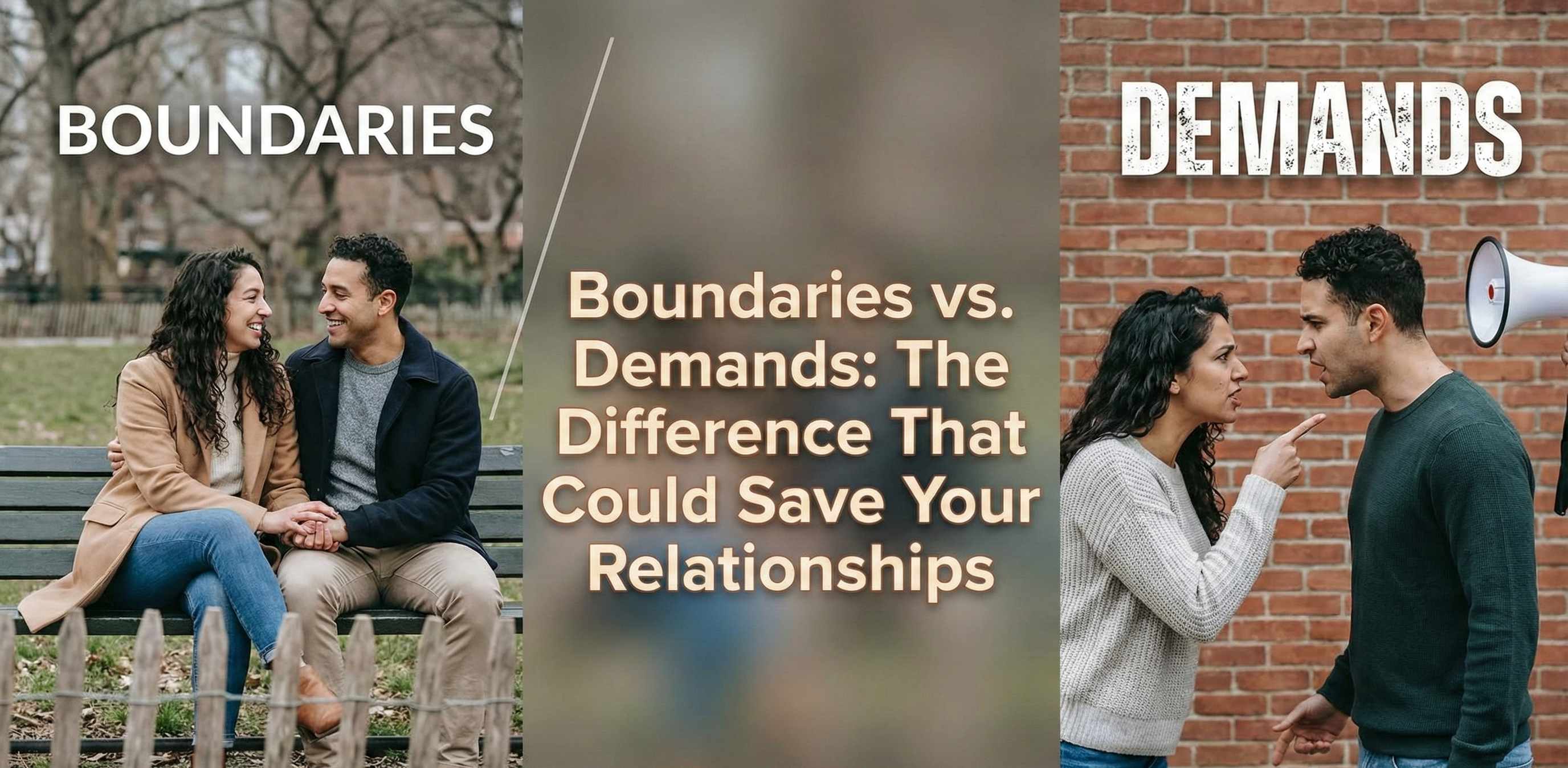
Let me tell you something uncomfortable:
Most of what we call “boundaries” are actually just demands wearing a self-help costume.
And the worst part? We’ve been taught to confuse the two.
I see this everywhere. In therapy offices. In relationship advice threads. In corporate HR trainings.
Someone says, “I’m setting a boundary,” and what they really mean is:
“I’m about to tell you exactly how you need to change so I feel better.”
That’s not a boundary. That’s control with a PR team.
Here’s the Truth Nobody Wants to Hear
A real boundary isn’t about what you do.
A real boundary is about what I will do to protect myself.
Let me show you the difference—because once you see it, you can’t unsee it.
The Boundary:
“If you raise your voice during our conversations, I will leave the room until we can talk calmly.”
The Demand:
“You need to stop yelling at me. It’s disrespectful and you have to change.”
See it?
One is about my action. The other is about your compliance.
One protects me. The other controls you.
Why This Matters More Than You Think
Because disguising demands as boundaries doesn’t just fail—it destroys trust.
Think about it:
When you tell someone, “You must never raise your voice when speaking to me,” what you’re really saying is:
“Your feelings, your stress, your reactions—they don’t matter. What matters is that you perform emotional labor to keep me comfortable.”
And when they inevitably fail to meet that standard?
You get to play the victim. “I set a boundary and you crossed it!”
Except you didn’t set a boundary. You issued an ultimatum.
The Anatomy of a Real Boundary
Here’s what an actual boundary looks like:
1. It starts with “I will…”
Not “You must…” or “You can’t…” or “You need to stop…”
2. It’s about self-protection, not other-control.
The goal isn’t to change their behavior. It’s to protect your well-being regardless of their choices.
3. It respects their autonomy.
They’re allowed to keep doing what they’re doing. You’re just choosing how you’ll respond.
4. It’s actionable by you alone.
You don’t need their permission, agreement, or cooperation. You just need to follow through.
Let’s Get Practical
Here are real scenarios. See if you can spot the difference:
Scenario 1: Financial Requests
Demand disguised as boundary: “You’re not allowed to ask me for money anymore. It stresses me out and you need to respect that.”
Actual boundary: “I don’t lend money to friends or family. If you ask, I’ll decline and we can move on to another topic.”
Scenario 2: Lateness
Demand disguised as boundary: “You have to text me if you’re going to be late. It’s rude not to and I won’t tolerate it.”
Actual boundary: “If you’re more than 15 minutes late without calling, I’ll start without you or make other plans.”
Scenario 3: Unsolicited Advice
Demand disguised as boundary: “Stop giving me advice when I just need to vent! You always do this and it has to stop.”
Actual boundary: “When I share a problem, I need you to just listen. If you start giving advice, I’ll politely end the conversation and we can talk later.”
The Uncomfortable Part
Here’s what makes this hard:
Real boundaries require you to do something.
Demands put the burden on the other person. They have to change. They have to comply. They have to perform.
Boundaries put the burden on you. You have to leave. You have to decline. You have to follow through.
And that’s scary.
Because it means you might actually have to:
- Walk away from a conversation
- End a relationship
- Say no to someone you love
- Accept that you can’t control how others behave
That’s why so many people prefer demands.
Demands let you stay comfortable while demanding others change.
Boundaries force you to take responsibility for your own well-being.
How to Tell If You’re Setting a Boundary or Making a Demand
Ask yourself these questions:
1. Can I enforce this without the other person’s cooperation?
If yes → boundary.
If no → demand.
2. Does this statement focus on what I will do or what they must do?
What I will do → boundary.
What they must do → demand.
3. Am I trying to change their behavior or protect my well-being?
Protect my well-being → boundary.
Change their behavior → demand.
4. Would I accept their right to continue the behavior, even if it means I follow through on my stated action?
Yes → boundary.
No → demand.
The Real Cost of Disguising Demands as Boundaries
When you impose demands and call them boundaries, you:
✗ Create resentment (they feel controlled)
✗ Invite defensiveness (they feel attacked)
✗ Lose credibility (your “boundaries” feel manipulative)
✗ Foster power struggles (neither side wins)
✗ Damage trust (the relationship becomes transactional)
When you set actual boundaries, you:
✓ Foster mutual respect (they understand your limits)
✓ Create clarity (expectations are transparent)
✓ Maintain your integrity (you follow through)
✓ Protect your well-being (without requiring their compliance)
✓ Build healthier relationships (based on respect, not control)
The Bottom Line
Boundaries protect you. Demands control others.
Boundaries say: “This is how I will take care of myself.”
Demands say: “This is how you must behave.”
One respects autonomy. The other denies it.
One is empowering. The other is exhausting.
And here’s the hardest truth of all:
If you can’t enforce it without their cooperation, it’s not a boundary—it’s a wish.
Stop wishing others would change.
Start protecting yourself.
That’s what boundaries are actually for.
Your Turn
Think about the last “boundary” you set.
Was it really a boundary? Or was it a demand wearing a therapy buzzword?
Be honest with yourself.
Because the difference between the two might be the difference between a relationship that thrives and one that slowly suffocates under the weight of unspoken control.
Choose wisely.
What “boundary” have you set that was actually a demand? Drop a comment—no judgment, just awareness.
