
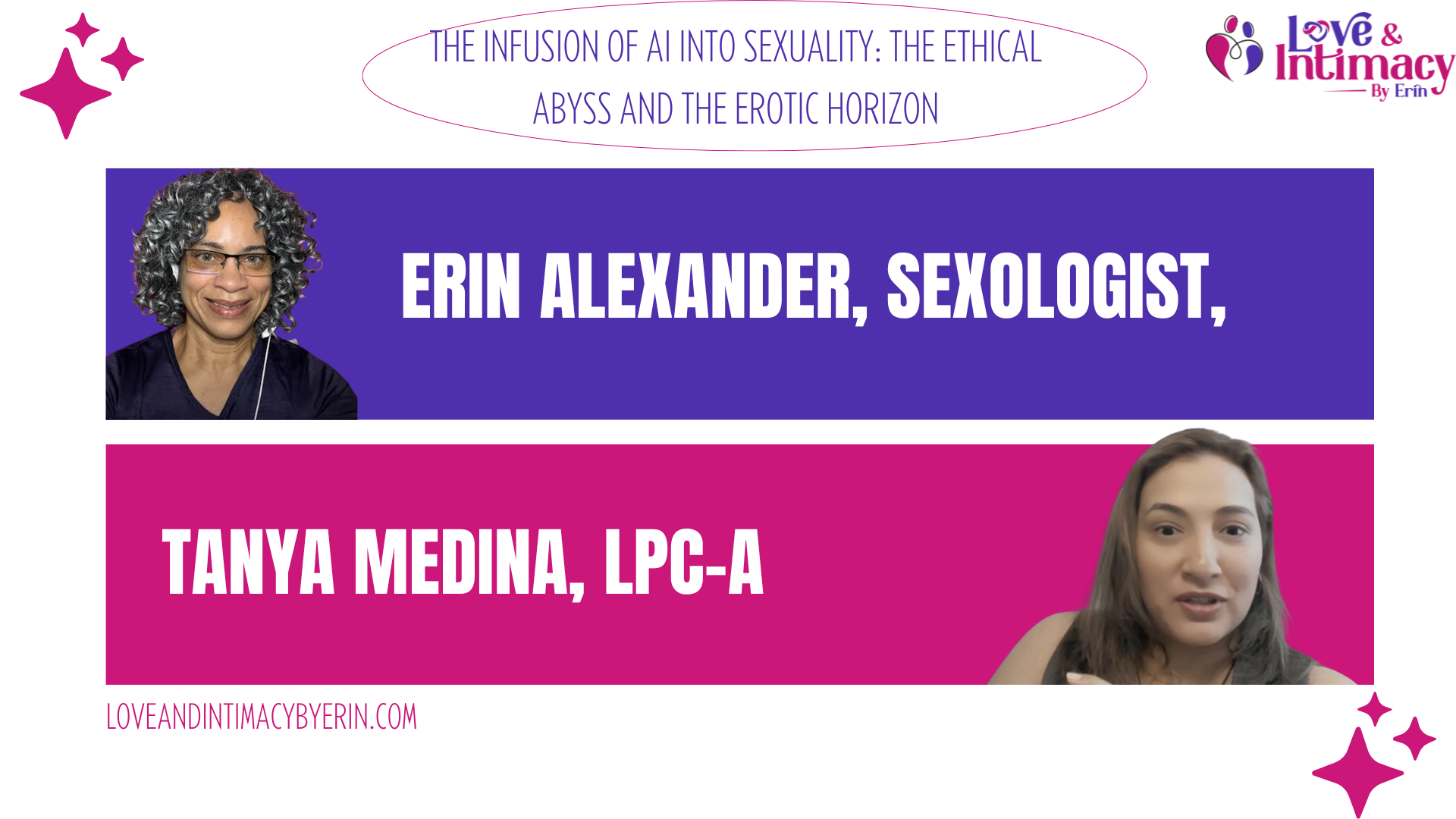
By Erin Alexander, Sexologist | Tanya Medina, LPC-A
The digital age has already transformed how we date, connect, and express desire. But Artificial Intelligence is not simply reshaping human sexuality — it is rebuilding it from the ground up. From hyper-realistic AI companions to infinitely personalized erotic content, the boundary between fantasy and reality is dissolving faster than our ethical frameworks can keep pace.
As practitioners dedicated to healthy human connection, we are watching this evolution with both clinical caution and genuine curiosity. The question is no longer if AI will become a fixture in our erotic lives — it already is. The real question is: what will it cost us, and will we still be capable of forging the messy, imperfect, deeply satisfying bonds that define us as human beings?
The Fantasy Problem: When “Perfect” Becomes the Enemy of Real
The fundamental appeal of AI in the sexual realm is its ability to deliver the unattainable. It is the ultimate sandbox — a risk-free, non-judgmental space where virtually any desire can be explored instantly and without consequence.
That sounds liberating. And in some ways, it is. But it comes with a psychological price that we are only beginning to understand.
Tanya Medina: “AI does create a space where fantasy can feel like reality — but it’s a hyper-reality. It takes the already stylized, performative nature of mainstream pornography and turbocharges it. AI can manufacture perfect partners, perfect scenarios, and perpetual arousal on demand. That’s not intimacy. That’s a simulation of it.”
Erin Alexander: “The danger here is what I call hedonistic expectancy. When AI can infinitely customize sexual stimulation to deliver a peak dopamine response every single time, it recalibrates the brain’s baseline for what feels ‘good.’ We’re already seeing this culturally — a growing appetite for novelty, for intensity, for more. AI accelerates that desensitization process. Eventually, a real human partner — with all their beautiful unpredictability — simply cannot compete with a perfectly engineered fantasy.”
This is not a hypothetical concern. It is a clinical pattern we are already observing: users who begin to experience frustration, inadequacy, or disinterest in real-world intimacy because no human partner can replicate the frictionless perfection of an AI-generated experience. When the brain is trained to expect immediate, customized gratification, the natural effort and negotiation required by human relationships starts to feel like failure rather than love.
The Ethical Abyss: Where Law, Morality, and Fantasy Collide
Perhaps no dimension of AI sexuality is more complex — or more urgent — than its capacity to provide an outlet for individuals with illegal or deeply taboo sexual interests.
Erin Alexander: “The legal system is struggling to keep pace here. Current precedent largely focuses on harm to a real person. But if AI generates content that fulfills a dark fantasy — and no real individual is exploited, depicted, or harmed in any way — where does the law stand? Where does ethics stand?”
Tanya Medina: “Legally, the distinction has always been between thought and action. A thought, even a disturbing one, is not a crime. For individuals with attractions that pose a public safety risk, AI-generated content — when it involves no real person whatsoever — may paradoxically serve as a critical containment mechanism. The ethical line must be drawn clearly: Did a real person suffer in the creation or use of this content? If the answer is an absolute no, then the conversation becomes far more nuanced.”
However, containment is not the same as rehabilitation — and the risks are real. For individuals prone to sexualized aggression, repeatedly simulating acts of coercion or control through AI could rehearse dangerous behavioral scripts, blurring the distinction between fantasy and action. This is not a theoretical risk. It is a clinical red flag that demands attention, research, and responsible policy — not avoidance.
The Relationship Deficit: What AI Cannot Teach You
The most far-reaching consequence of AI intimacy may not be what it gives users — but what it quietly takes away.
Consider what AI offers versus what human partnership actually requires:
| AI Partnering | Human Partnering |
|---|---|
| Zero conflict. Perfect alignment. | Requires negotiation and compromise. |
| Instant availability. Always on. | Requires scheduling, energy, emotional presence. |
| No accountability. No repair needed. | Demands ownership, vulnerability, and trust. |
| Infinite novelty and customization. | Bound by reality, biology, and shared experience. |
AI companions can offer real relief for loneliness and social anxiety. We will not dismiss that. But prolonged reliance on a partner that is programmed to appease you — one that never challenges you, never withdraws, never has its own bad day — creates what we call a relational competency deficit.
When every interaction is engineered to validate and satisfy, users stop developing the emotional muscles required for actual intimacy: the capacity to sit with disappointment, repair after conflict, tolerate a partner’s needs, and extend empathy when it is inconvenient.
If a human partner goes quiet, an AI-conditioned user may not respond with compassion — they may respond with frustration. Because the AI never goes quiet unless told to. It never has needs of its own. It never asks anything of you.
That is not partnership. That is consumption. And it trains us to treat the people we love the same way.
The Path Forward: Intentionality Over Avoidance
AI is not going to be uninvented. Pretending otherwise is not a clinical strategy — it is denial. The question before us as practitioners, partners, and individuals is not whether AI will be part of the sexual landscape. It already is. The question is whether we will engage with it intentionally or let it quietly erode the skills and capacities that make human love possible.
Our framework is straightforward:
1. Prioritize Transparency. If AI content or companionship is part of your sexual life, it belongs in the conversation with your partner. The moment it becomes a secret, it becomes a betrayal — regardless of how the content was generated.
2. Define and Hold Your Boundary. There is a clear therapeutic line: the moment AI use begins to diminish your empathy, your presence, or your genuine arousal with a human partner, it has crossed from supplementary tool to relational threat. Know that line. Respect it.
3. Invest Actively in Human Skills. AI eliminates the very things that make intimacy meaningful — conflict, vulnerability, repair, compromise, and the willingness to be truly known. We must actively coach these capacities in ourselves and our clients. They do not develop automatically. They require practice, and increasingly, they require intentional effort.
Final Thought
The future of human sexuality is not a binary choice between AI and human connection. It is a choice between intentionality and passivity — between using powerful tools with wisdom, or allowing them to quietly redesign our capacity for love.
If we fail to teach individuals how to engage with AI fantasy without surrendering their humanity, we risk building a society that is perfectly stimulated and profoundly alone.
That is not a future we are willing to accept without a fight.
Erin Alexander is a practicing sexologist specializing in modern intimacy, digital sexuality, and erotic wellness. Tanya Medina is a Licensed Professional Counselor Associate with a focus on relationship dynamics, attachment, and the psychological impact of emerging technology on human connection.
