
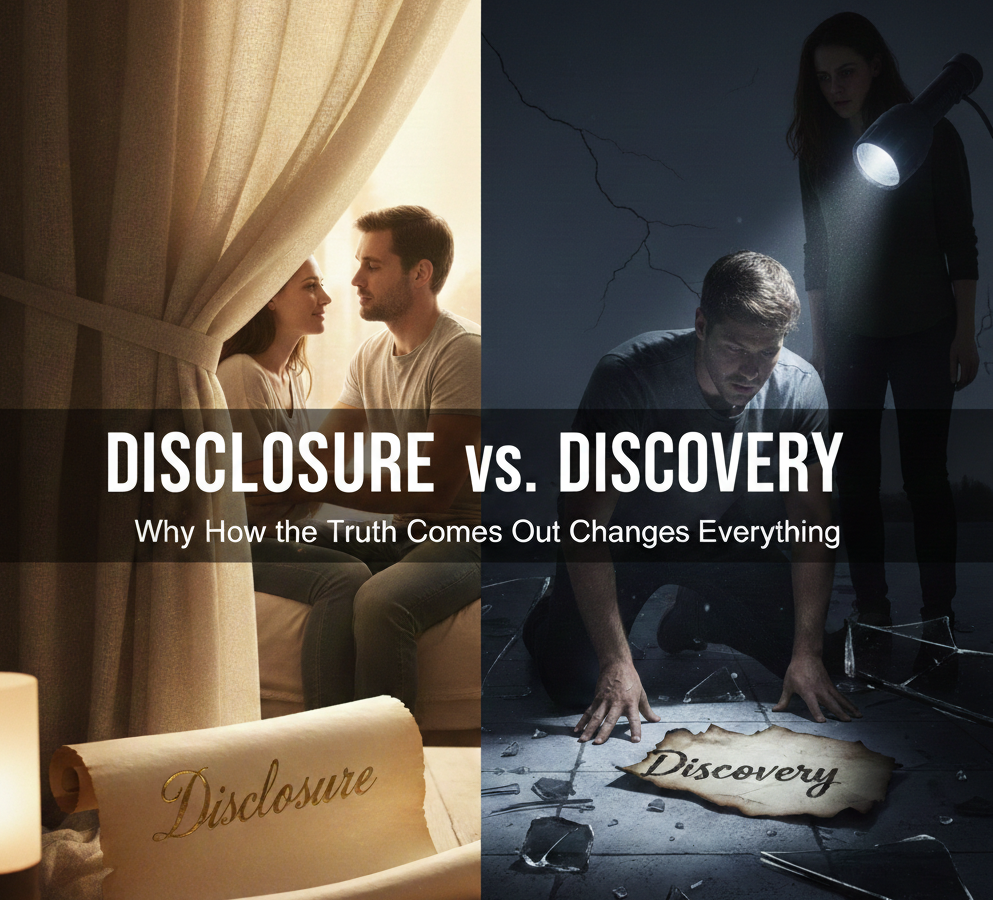
When trust is broken whether through infidelity, repeated lies, or hidden secrets, most people focus on the what. What happened. What was hidden. What was done.
But there’s a question that shapes the entire healing journey even more powerfully:
How did the truth come out?
This single factor, disclosure versus discovery, fundamentally determines the pace, the pain, and the possibility of recovery in a relationship. Understanding the difference isn’t just important. It’s everything.
What Is Disclosure?
Disclosure happens when the person who broke trust voluntarily comes forward and tells the truth, before they’re caught, before they’re cornered, before their partner stumbles onto something they weren’t supposed to find.
It’s not comfortable. It’s not easy. But it is one of the most powerful acts of integrity a person can choose.
Why Disclosure Leads to Healing
1. You control the narrative. When you choose to disclose, you take ownership of the story. You can deliver the truth with intention and care — answering the questions that matter most, rather than letting your partner piece together fragments of a devastating picture on their own.
2. You limit your partner’s trauma. There is an enormous difference between being told a painful truth and accidentally stumbling onto one. Disclosure doesn’t eliminate the pain, but it significantly reduces the shock and the secondary trauma that comes with feeling blindsided.
3. You create a clear foundation for repair. Disclosure is the first act of rebuilding. It communicates something critical to a wounded partner: “I am taking responsibility. I want to fix this.” That foundation, flawed and painful as it is, gives both people somewhere solid to stand.
4. You preserve your integrity. When you disclose, you get to define yourself by your willingness to be honest rather than your capacity to deceive. That distinction matters enormously, both to your partner and to you.
What Is Discovery?
Discovery is when the betrayed partner uncovers the truth on their own, in a text message, a bank statement, an overheard phone call, a gut feeling that finally got confirmed.
Discovery is not just painful. It is, in many ways, a second betrayal.
Why Discovery Devastates Recovery
1. It causes maximum trauma. Discovery ignites chaos. The message it sends is brutal: “The lying would have continued if you hadn’t caught me.” That understanding, that deception was the active, ongoing choice, compounds the original wound in a way that is extraordinarily difficult to heal.
2. It creates secondary injuries. The initial betrayal is one wound. But the cover-up, the gaslighting, the active effort to maintain the lie? Those become their own injuries, and research and clinical experience consistently show that secondary injuries are often harder to heal than the original betrayal itself.
3. It forces your partner into the detective role. Discovery puts the burden of proof on the victim. They must now invest their emotional and mental energy into hunting for evidence, confronting with proof, and confirming details they never wanted to know. This is an unfair, exhausting, and dehumanizing role that extends the recovery timeline by months, sometimes years.
4. It leaves the door open to ongoing fear. After discovery, the betrayed partner is haunted by a question that never fully goes away: Is there more? That fear makes establishing a safe baseline for recovery nearly impossible.
The Bottom Line: Accountability Changes Everything
Disclosure is the ultimate act of radical accountability. It is the only choice that frames a failure as a past mistake that is actively being corrected, rather than a lie that was only stopped by external forces.
Discovery, by contrast, places the moral burden on the wrong person. It hands the victim the job of seeking justice while leaving the person who caused harm passively waiting to be caught.
The truth always hurts. But the way it arrives can be the difference between a crisis that eventually leads to healing, and one that leads to total collapse.
If you are holding a truth that someone you love deserves to know, the most healing, most accountable, most courageous thing you can do is tell them yourself. That choice belongs to you. Make it count.
If you’re navigating betrayal or affair recovery, whether as the person who broke trust or the one who was hurt, working with a licensed therapist who specializes in relational trauma can be a transformative part of the healing process.
