
Relationships · The Unscripted Equation · 5 min read
Navigating the delicate balance between intimacy and personal space — and why letting your partner breathe is the best thing you can do for your relationship.
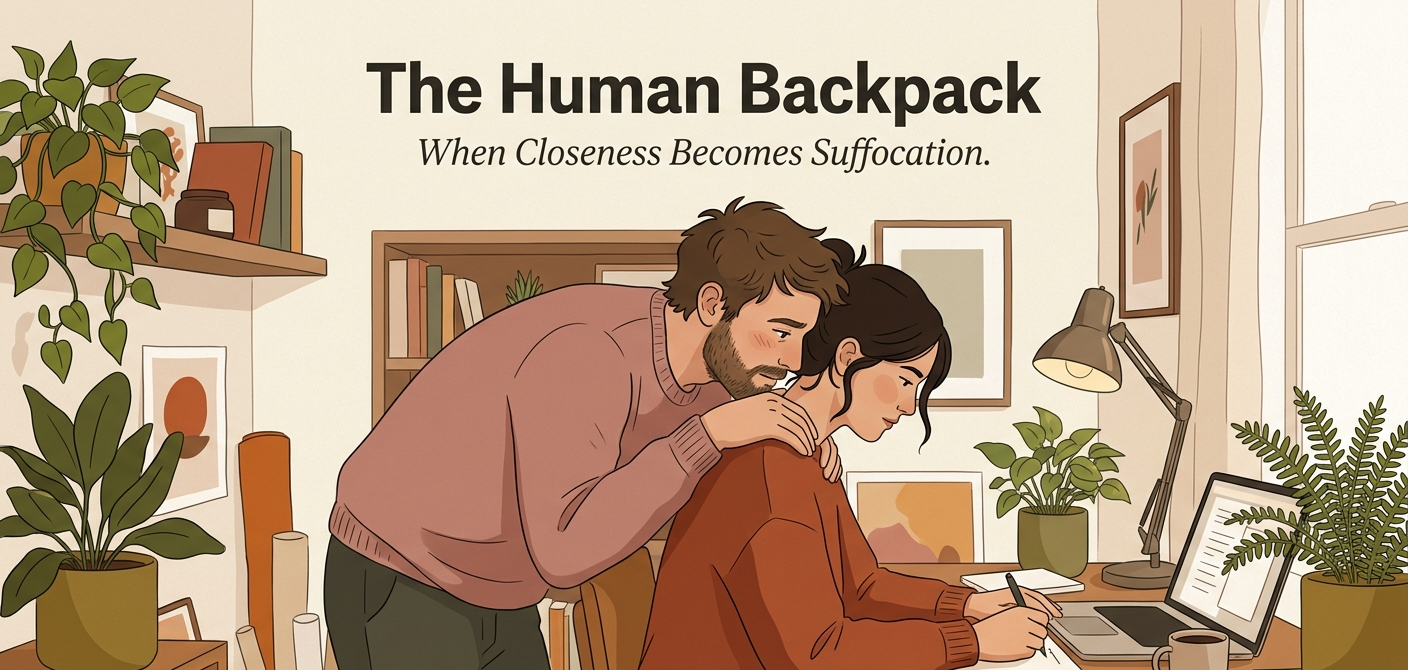
Have you ever felt like your partner is effectively wearing you like a backpack? Constantly hovering, doting, needing a tangible presence just to feel secure? On a recent episode of The Unscripted Equation, Tanya and I waded deep into what I lovingly call The Great Snuggle Swamp — that precarious moment in a relationship where one partner’s genuine desire for closeness inadvertently turns the other’s personal space into an endangered ecosystem.
If any of that sounds familiar, keep reading. This one’s for you.
Meet Samantha and Victor
To understand this dynamic, let’s look at a classic example. Samantha and Victor are a couple whose differing attachment and conflict styles collide in spectacular fashion, especially under stress.
| Partner | Attachment Style | Conflict Style | Needs During Stress |
|---|---|---|---|
| Samantha | Secure | Collaborative | Space, solitude, and a “protective bubble” to recharge |
| Victor | Anxious | Competitive | Proximity, reassurance, and constant physical presence |
When Samantha is slammed with work, her instinct is to withdraw and recharge in solitude. Completely healthy. But Victor? The moment he senses even the slightest emotional distance, his internal alarm system interprets it as a Category 5 relationship hurricane. Cue Operation Human Backpack.
Suddenly, Victor is dishing out unsolicited dicing advice in the kitchen. He’s perfecting what I call the “clam-shell maneuver” annexing 90% of the mattress in search of closeness. He’s not being malicious. He’s just terrified. And that fear, unchecked, becomes suffocating.
“The core issue isn’t a lack of love. It’s a failure of self-soothing.”
Why It Happens: The Anxiety-Avoidance Trap
For someone like Victor, an anxious attachment style means his nervous system genuinely cannot distinguish between “my partner needs an hour alone” and “my partner is leaving me.” The brain doesn’t care about nuance when it’s in threat mode.
The first step out of this cycle is learning to differentiate between a healthy desire for closeness and a fear-driven need for constant proximity. One comes from love. The other comes from anxiety. They feel the same from the inside, which is precisely what makes this so tricky.
The Prescription: Space Is Not a Four-Letter Word
Breaking the cycle requires a blend of humor, strategy, and explicit communication. Here are three tools that actually work:
1. The Compromise Zone – Strategic Solitude
Samantha needs to articulate her need for space as fuel, not rejection. And here’s the key: schedule “Snuggle Sessions” on the other side of that alone time. When Victor has a guaranteed moment of connection to look forward to, his internal alarm quiets down significantly. He gets a promise, not a void.
2. Parallel Play for Adults
Victor doesn’t have to be a Human Backpack to feel close. Redefine proximity as parallel play, being in the same room but occupied with separate activities. One of you reads, the other games with headphones on. You’re together without the pressure of constant engagement. It sounds simple because it is. But it works.
3. The “Pickle Jar” Signal
Sometimes you’re too deep in stress mode to articulate why you need space. Agree on a ridiculous code word, like “Pickle Jar”, to signal an immediate, no-questions-asked time-out. It cuts tension with humor, sets a firm boundary, and removes the emotional labor of having to explain yourself mid-meltdown. The rule? When the code word is invoked, it is honored. No sulking, no follow-up questions.
The Bottom Line
A relationship’s job is to enhance both people’s lives, not to become a cage. Letting your partner breathe doesn’t mean you’re drifting apart. It means they’ll come back with more oxygen, more energy, and honestly? Way better snuggles.
If this resonated with you, tune in to the full episode of The Unscripted Equation for a deeper dive into attachment styles, relational dynamics, and why Victor really needs to stop offering kitchen commentary.
Have a “Pickle Jar” moment of your own? A dynamic that sounds a little too familiar? Drop it in the comments — I’d love to hear how you navigate the swamp.
