
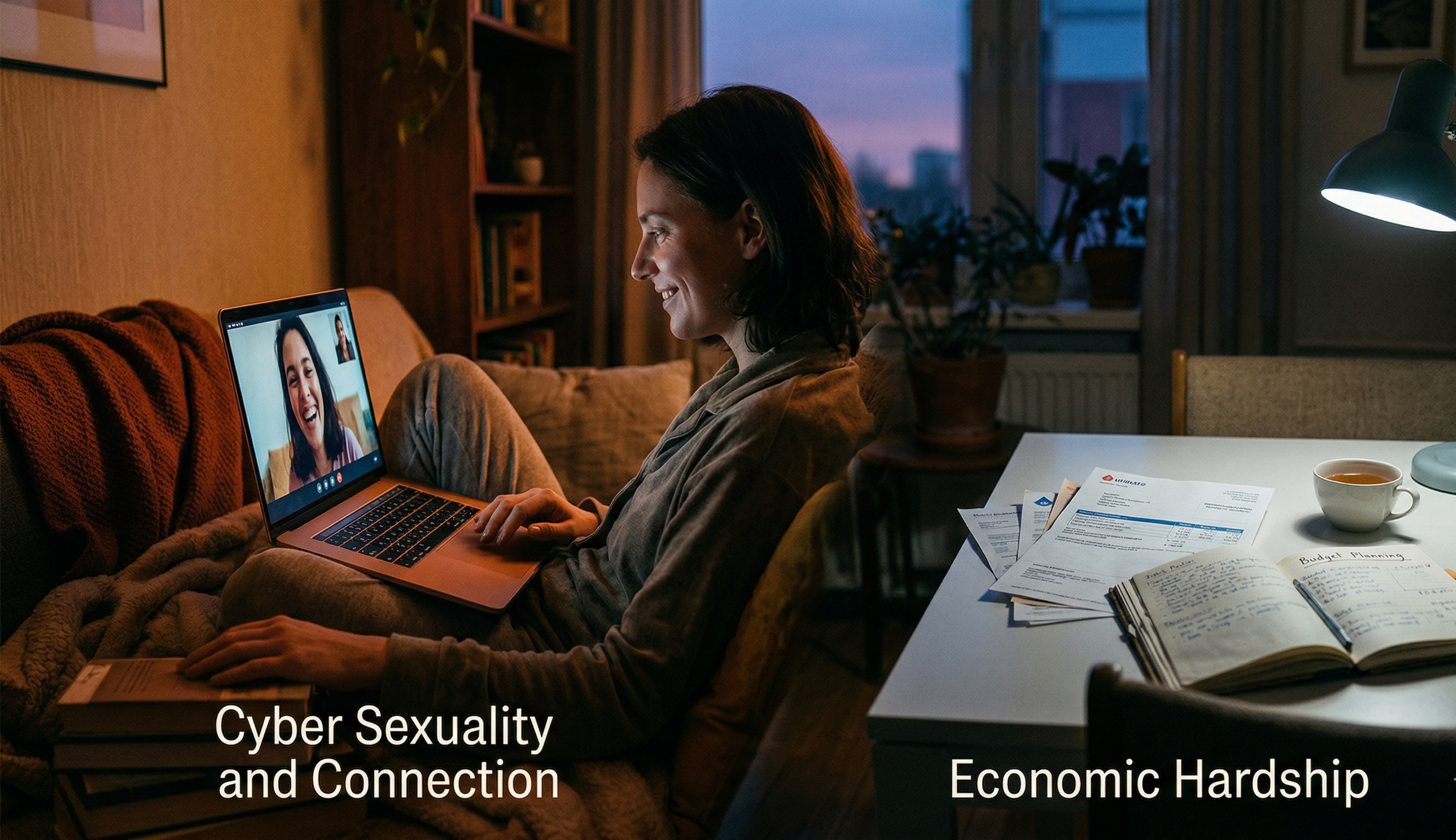
How technology reshapes intimacy, why pleasure skills matter when money’s tight, and navigating dating when your bank account is screaming
By Ms. Erin Alexander, Clinical Sexologist
The Digital Revolution in Sexuality (And Why It Matters When Money’s Tight)
Hey there. Ms. Erin here.
Let’s talk about something that’s fundamentally changed in the last 15 years but that we rarely discuss honestly: how technology has completely reshaped sexuality, intimacy, and dating and why that matters even more when you’re struggling financially.
Here’s the reality: Technology isn’t just a tool for sexuality. It’s become a new terrain for desire entirely.
The digital realm has fundamentally altered:
- How we communicate about sex
- How we form relationships
- What we consider “normal” sexually
- How we express desire and negotiate intimacy
- How we can experience connection when traditional dating feels financially impossible
And here’s what makes this particularly relevant right now: We’re living through significant economic hardship for many people.
Dating is expensive. Going out costs money. Traditional courtship dinner, drinks, activities, gifts requires disposable income that a lot of people simply don’t have.
But sexuality, pleasure, and connection don’t pause just because your bank account is stressed.
So today, we’re talking about:
- How cyber sexuality and digital tools have changed the landscape
- The risks and benefits of technology in sexual spaces
- Pleasure enhancement skills that are free, accessible, and powerful
- How to maintain intimacy and dating during financial stress
Because sexual wellness isn’t a luxury reserved for people with money. It’s a fundamental component of human well-being, accessible to everyone.
How Technology Reshapes the Erotic Landscape
Cyber sexuality refers to the entire ecosystem of how technology intersects with sexual expression, identity, communication, and connection.
What’s Changed:
Before widespread internet:
- Sexual information was limited, often inaccurate
- Diverse sexual identities and practices were hidden
- Finding community required physical proximity
- Sexual communication was slower, more private
- Dating required in-person interaction
Now:
- Sexual information is ubiquitous (for better and worse)
- Conversations about diverse identities and practices are normalized
- Communities exist globally, accessible from your phone
- Sexual communication is instantaneous
- Dating can begin entirely online
- Intimacy can be fostered through screens
The Impact of the Digital Sphere:
The internet provides a vast, often anonymous space for exploration.
This has:
Normalized conversations around diverse sexual identities and practices that were once stigmatized
Created access to sexual education and community
Enabled connection for people who are geographically isolated or marginalized
Provided platforms for sexual expression and exploration
But also:
Blurred lines between public and private
Created new risks around privacy, safety, and consent
Introduced new pressures around performance and appearance
Complicated intimacy with superficiality and gamification
The reality: Technology is neither purely good nor purely bad for sexuality. It’s a tool, and like any tool, the outcome depends on how we use it.
Where Sexuality Happens Digitally:
Social media platforms and messaging apps are now primary venues for:
- Flirting
- Expressing attraction
- Negotiating consent
- Sexting and digital intimacy
- Forming romantic and sexual connections
This is the landscape we’re navigating. Understanding it is essential for sexual health in 2025.
Online Dating, Pornography, and Digital Intimacy: The Tools of Cyber Sexuality
Let’s break down the major digital tools shaping sexuality today.
Online Dating: The Gamification of Connection
What’s happened: Dating apps have streamlined relationship formation, offering access to hundreds or thousands of potential partners.
The benefits:
- Efficient matching based on preferences
- Access to people outside your immediate social circle
- Ability to be explicit about what you’re looking for
- Lower barrier to initial contact (less rejection anxiety)
The challenges:
- “Gamification” can lead to treating people as disposable
- Paradox of choice (too many options = decision paralysis)
- Superficiality (decisions based on photos and brief bios)
- “Dating burnout” from constant swiping and messaging
- Economic pressure (many apps have premium features requiring payment)
My take: Online dating is a tool. Used intentionally, it can facilitate genuine connection. Used mindlessly, it can create exhaustion and cynicism.
Tips for healthier online dating:
- Set boundaries on time spent swiping
- Focus on quality of conversations, not quantity of matches
- Be honest about what you’re looking for
- Move to in-person meetings relatively quickly (if compatible)
- Remember that free versions of apps still work you don’t need premium to connect
Pornography: Ubiquitous Access and Its Impact
The reality: Digital access to pornography is ubiquitous. Most people, regardless of gender, have consumed it.
Potential benefits:
- Tool for self-discovery and understanding your desires
- Safe space for exploring fantasies you might not want in reality
- Source of pleasure and sexual release
- Can provide ideas for partnered sex
Potential harms:
- Unrealistic standards for sexual performance and body image
- Distorted expectations about sex (what “should” happen, how long it “should” last)
- Desensitization requiring increasingly intense content for arousal
- Potential impact on real-world intimacy and connection
- Can become compulsive or interfere with relationships
The key: Conscious consumption rather than reflexive use.
Questions to ask yourself:
- Does my pornography consumption enhance my sexuality or replace real connection?
- Are my expectations for sex shaped by performance rather than authentic pleasure?
- Can I be aroused by real partners and real encounters, or only by screen content?
- Is my consumption intentional or compulsive?
(See my full guide on pornography and relationships for deeper exploration of this topic.)
Digital Intimacy: Connection Through Screens
What it is: Emotional and sexual connection fostered through digital means sexting, video calls, shared fantasies, voice messages, online games together.
Why this matters, especially during economic hardship:
Digital intimacy offers low-cost, accessible forms of connection.
When you can’t afford expensive dates, digital intimacy allows you to:
- Build emotional connection without spending money
- Maintain sexual connection in long-distance relationships
- Explore desires and fantasies through conversation
- Experience intimacy when physical proximity isn’t possible
But it requires:
- Clear boundaries (what you’re comfortable sharing digitally)
- Mutual respect (consent applies to digital spaces too)
- Understanding of risks (see safety section below)
- Balance (digital intimacy supplements but shouldn’t entirely replace physical connection)
My framework: Digital intimacy is legitimate intimacy. It’s not “less than” in-person connection—it’s a different form with its own value and challenges.
Staying Safe in Digital Sexual Spaces
The digital landscape, particularly concerning sexuality, carries real risks. Let’s address them directly.
Privacy Risks and Protection
Risks:
- Data breaches exposing personal information
- Location tracking revealing where you live/work
- Non-consensual sharing of intimate images (revenge porn)
- Screenshots or recordings of private content
- Metadata in photos revealing location/identity
Protection strategies:
Use strong, unique passwords for all apps and platforms
Enable two-factor authentication where available
Manage app permissions carefully (does a dating app really need access to your contacts?)
Never share explicit content without clear, enthusiastic agreement about boundaries and use
Remove metadata from photos before sharing (many phones embed location data)
Use apps with end-to-end encryption for sensitive conversations
Assume anything sent digitally could become permanent and public
My rule: If you wouldn’t want it on a billboard with your name, think very carefully before sending it digitally.
Safety Risks and Protection
Risks:
- Grooming and manipulation
- Catfishing (fake identities)
- Meeting strangers in unsafe environments
- Pressure for unsafe activities
- Stalking and harassment
Protection strategies:
- Always meet in public places initially (coffee shops, restaurants, parks)
- Share your location with a trusted friend when meeting someone new
- Tell someone who you’re meeting, when, and where
- Trust your instincts (if something feels off, it probably is)
- Vet connections thoroughly before meeting offline (video chat first)
- Don’t share your home address until you’ve established trust
- Have your own transportation so you can leave whenever you want
Red flags to watch for:
- Refusing to video chat before meeting
- Pushing to meet immediately
- Asking for money or financial information
- Love-bombing (overwhelming affection too quickly)
- Inconsistencies in their story
- Pressure to move communication off the app immediately
Cyberbullying, Harassment, and Sexual Shaming
Risks:
- Sexual shaming and slut-shaming
- Derogatory comments about body, appearance, or sexual choices
- Persistent unwanted digital contact
- Sharing of private information or images without consent
- Online stalking and monitoring
Protection strategies:
- Block immediately without explanation if someone is abusive
- Report abusive behavior to the platform
- Document everything (screenshots with dates/times)
- Don’t engage with harassers (engagement often escalates)
- Prioritize your mental health over “not letting them win”
- Detach from toxic digital spaces (sometimes the answer is leaving the platform)
- Seek support from friends, therapist, or online harassment resources
Remember: You don’t owe anyone your time, attention, or access to you. Block liberally. Protect your peace.
Pleasure Enhancement Skills: Free, Accessible, and Powerful
Here’s what most people don’t realize: The most powerful tools for sexual well-being are free, always accessible, and don’t require a partner.
Sexual health is intrinsically linked to mental and emotional well-being. Cultivating sexual awareness and pleasure is a fundamental component of a resilient, fulfilling life, regardless of your bank balance.
Skill #1: Mindfulness in Sexual Contexts
What it is: Bringing non-judgmental attention to the present moment, specifically applied to sexual sensation and experience.
How to practice:
During solo sex:
- Focus purely on physical sensation (touch, temperature, texture)
- Notice your breath
- When your mind wanders (to grocery lists, work stress, performance anxiety), gently bring it back to sensation
- Pay attention to what actually feels good, not what you think “should” feel good
During partnered sex:
- Stay present with your actual experience, not fantasizing or performing
- Notice sensations in your body
- Observe your partner without judgment
- Let go of outcome focus (orgasm as goal) and embrace the journey
Why this matters:
- Increases pleasure and satisfaction
- Reduces performance anxiety
- Improves connection with partners
- Makes sex more embodied and authentic
- Costs nothing and is always available
Skill #2: Erotic Mapping (Understanding Your Pleasure Blueprint)
What it is: Personalized exploration of your own body and pleasure responses—an ongoing process of identifying what truly excites and satisfies you.
How to practice:
Physical mapping:
- Explore your entire body (not just genitals)
- Experiment with different types of touch (firm, light, rhythmic, varied)
- Notice what areas are particularly responsive
- Discover new erogenous zones
Psychological mapping:
- What thoughts, fantasies, or scenarios arouse you?
- What emotional states enhance or diminish desire?
- What contexts (time of day, environment, level of stress) affect your sexuality?
- What power dynamics or relationship structures appeal to you?
Why this matters:
- Moves you beyond societal scripts and “default settings”
- Critical for effective communication with partners
- Increases sexual satisfaction
- Allows you to ask for what you actually want
- Entirely free and self-directed
Skill #3: Self-Pleasure as Essential Practice
What it is: Masturbation as a deliberate practice for sexual self-literacy, stress relief, and pleasure.
Why it’s essential:
Understand your needs without pressure of a partner
Learn your physiological responses (arousal patterns, what works)
Stress relief (orgasm releases endorphins and reduces cortisol)
Self-care that’s always accessible
Body connection and acceptance
Sleep aid (for many people)
Reframing masturbation:
From: Shameful, secretive, “less than” partnered sex, only when you’re single
To: Essential sexual practice, legitimate form of sexuality, important regardless of relationship status
My framework: Self-pleasure is not a consolation prize when you don’t have a partner. It’s a fundamental component of sexual health, period.
Skill #4: Body Positivity as Sexual Foundation
What it is: Embracing your body as a source of pleasure and strength, exactly as it is right now.
Why this matters during economic hardship:
Financial stress often exacerbates feelings of insecurity and self-doubt. Messages about inadequacy are everywhere when you’re struggling economically.
Actively practicing body positivity is an empowering counter-narrative.
How to practice:
Focus on function over appearance (what can your body do and feel?)
Celebrate pleasure (your body as a source of joy, not just an object to be judged)
Challenge negative self-talk (would you talk to a friend this way?)
Limit media consumption that makes you feel inadequate
Practice gratitude for your body’s capabilities
The connection to sexuality:
You cannot be fully present and engaged sexually if you’re constantly monitoring and criticizing your body.
Body positivity allows you to:
- Experience pleasure without distraction
- Be vulnerable with partners
- Ask for what you want without shame
- Enjoy sensation without judgment
And it’s entirely free.
Dating and Intimacy During Economic Hardship: Practical Strategies
Here’s the uncomfortable reality: Dating and intimacy don’t pause during financial stress. They often become more complicated and more essential simultaneously.
Traditional dating is expensive. Dinner, drinks, activities, gifts, transportation—it adds up fast.
But connection, intimacy, and pleasure are fundamental human needs that don’t wait for your bank account to recover.
So how do you navigate this? By using the cyber sexuality tools and pleasure enhancement skills we’ve discussed.
Challenge #1: Stress and Anxiety Kill Libido
The problem: High cortisol (stress hormone) decreases libido. Financial stress is chronic stress.
When you’re worried about rent, bills, or job security, sex often feels like the last thing you have energy for.
The solution: Mindfulness and self-pleasure as free stress reduction.
How it works:
- Masturbation releases endorphins (natural stress relief)
- Mindful touch activates parasympathetic nervous system (calms you down)
- Orgasm temporarily reduces cortisol
- Sexual pleasure provides escape from stress
The benefit for dating:
- Improves mood and emotional availability
- Makes you a more present, engaging partner
- Reduces stress-related irritability
- Restores sense of pleasure and agency
You become a better partner not because you spent money, but because you managed your stress effectively.
Challenge #2: Lack of Funds for Traditional Dates
The problem: You can’t afford expensive dinners, drinks, activities, or gifts that traditional dating requires.
This creates:
- Shame about what you can’t provide
- Avoidance of dating entirely
- Accepting less-compatible partners because they pay
- Pressure to spend money you don’t have
The solution: Digital intimacy and creative, low-cost connection.
Free or low-cost date ideas:
Digital dates:
- Video calls where you cook “together” (same recipe, separate kitchens)
- Watch a movie simultaneously while video chatting
- Play online games together
- Share music and discuss what it means to you
- Take virtual museum tours together
- Read the same book and discuss
In-person, low-cost dates:
- Picnics in parks (bring homemade food)
- Hiking or walking trails
- Free museum days or art galleries
- Attend free community events
- Cook together at home
- Stargazing
- Explore your city as tourists
The benefit:
- Encourages deeper emotional connection over superficial, transactional dating
- Focuses on compatibility rather than who can spend more
- Saves money while still building intimacy
- Attracts partners who value genuine connection over wealth
The reframe: Quality time and authentic connection matter more than expensive venues.
Challenge #3: Time Constraints (Multiple Jobs, Long Commutes)
The problem: Financial stress often means working multiple jobs, long hours, or exhausting commutes. You don’t have time for lengthy dates.
The solution: Erotic mapping and direct communication for efficient, high-quality intimacy.
How it works:
Because you’ve done the work of understanding exactly what you want (erotic mapping), you can:
- Communicate clearly and efficiently
- Ask for what you need directly
- Avoid time-wasting guessing games
- Focus quality time together on what actually matters
Example:
Instead of: Lengthy, meandering dates hoping chemistry happens
Try: Clear communication about attraction, direct conversation about compatibility, efficient planning for limited time together
The benefit:
- Higher-quality sexual experiences when time is limited
- Focus shifts from quantity of dates to quality of intimacy
- Respect for each other’s time and constraints
- Authentic connection rather than performative dating
Challenge #4: Low Self-Esteem Due to Financial Struggle
The problem: Feeling inadequate, ashamed, or “less than” because of financial situation.
This manifests as:
- Avoiding dating entirely
- Accepting poor treatment because “you should be grateful”
- Over-compensating by spending money you don’t have
- Hiding your situation, creating inauthenticity
The solution: Body positivity and pleasure-focused self-worth.
The reframe: Your value is not determined by your bank balance.
Your body is a powerful source of pleasure, independent of material status. Your capacity for connection, intimacy, and authentic presence matters far more than what you can buy.
How to practice:
Focus on what you bring: emotional availability, authenticity, presence, pleasure, communication skills
Choose partners who value genuine connection over wealth
Be honest about your situation (the right people won’t care)
Remember that sexual compatibility and emotional connection are priceless
The benefit:
- Increased confidence and authenticity
- Attracts partners who value you for who you are
- Eliminates shame that creates barriers to intimacy
- Focuses on sustainable connection rather than unsustainable performance
The Bottom Line: Sexual Wellness Is Always Accessible
Here’s what I need you to understand:
Sexual wellness, pleasure, and connection are not luxuries reserved for people with disposable income.
They are fundamental components of human well-being, accessible to everyone.
The Digital Revolution Offers Tools:
Digital intimacy as low-cost connection
Online communities for support and information
Access to sexual education and resources
Platforms for finding compatible partners
But true sexual resilience comes from within.
The Pleasure Enhancement Skills That Are Always Free:
Mindfulness in sexual contexts
Erotic mapping to understand your desires
Self-pleasure as essential practice
Body positivity as foundation
Clear communication about needs and boundaries
These skills:
- Cost nothing
- Are always accessible
- Don’t require a partner
- Improve with practice
- Create genuine sexual resilience
During Economic Hardship:
Your sexuality doesn’t disappear. Your need for connection doesn’t pause. Your capacity for pleasure doesn’t depend on your bank account.
What changes is how you access and cultivate these things.
By mastering pleasure enhancement skills and using digital tools intentionally, you can:
- Maintain intimacy and connection during financial stress
- Experience pleasure and reduce stress for free
- Date authentically without financial performance
- Build sexual confidence independent of material status
- Reclaim your sexual power regardless of your bank balance
The Truth:
Desire and connection remain vital, accessible sources of joy—no money required.
Your sexuality is yours. Your pleasure is yours. Your capacity for connection is yours.
Economic hardship is real and difficult. But it doesn’t get to take your sexuality from you too.
Sexual wellness is a right, not a privilege. It doesn’t require money, just awareness, practice, and intention.
